

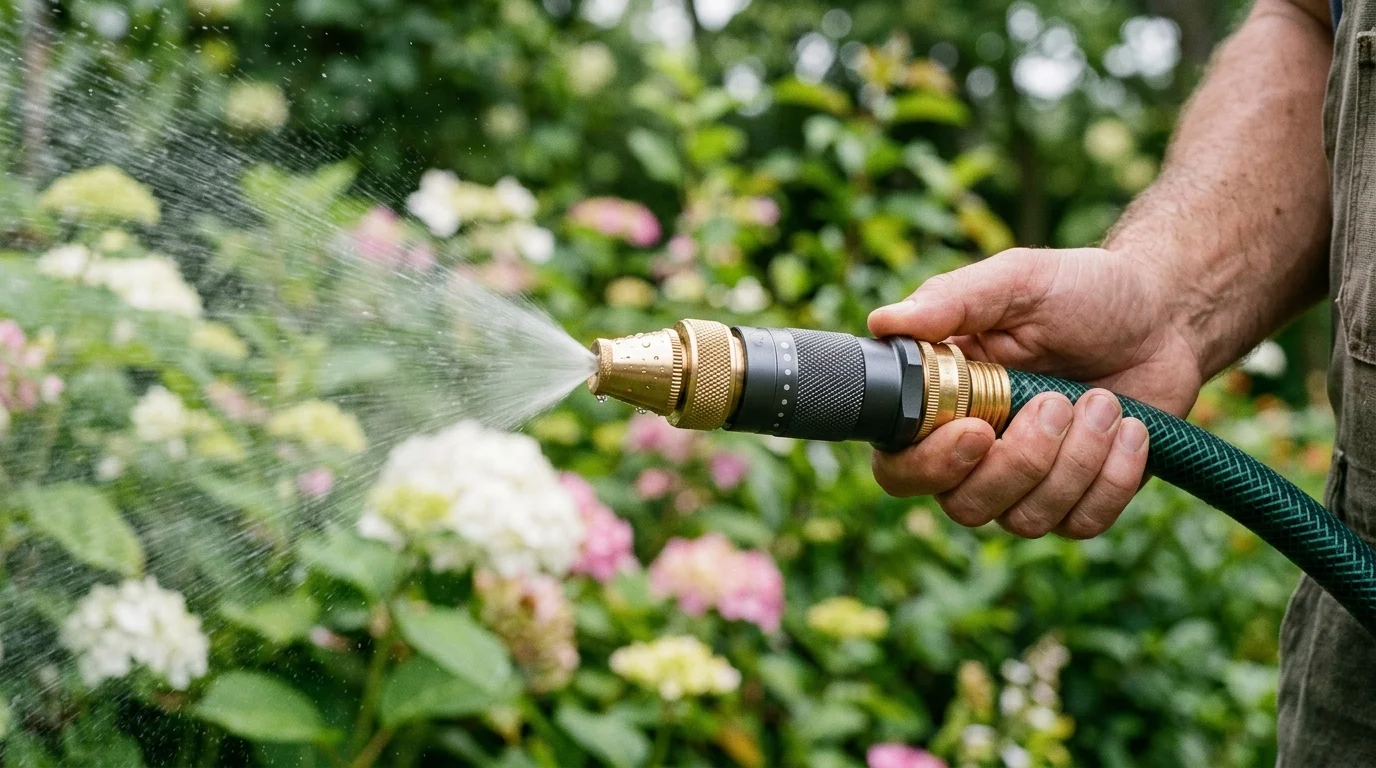
Why Adjustable Flow Rate Nozzles Matter
Fire suppression tactics rely heavily on the efficient, precise, and adaptable application of water. Adjustable flow rate nozzles, frequently referred to in the industry as selectable-gallonage nozzles, represent a critical evolution in fire stream management. By allowing the nozzle operator to manually dictate the volume of water discharged without halting operations or shutting down the hose line, these devices offer profound tactical advantages over legacy fixed-flow equipment.
The fundamental mechanics of an adjustable flow rate nozzle involve a rotating selector ring located behind the bumper. This ring adjusts the internal baffle spacing or orifice size, effectively metering the water flow. In high-stakes environments where fire behavior can shift in seconds, possessing the capability to instantly modify the suppression stream’s thermal absorption capacity is a vital asset for modern fire departments.
Tactical flexibility and flow control
The modern fireground is highly dynamic, often requiring rapid transitions between offensive and defensive strategies. Tactical flexibility is the primary benefit of adjustable flow rate nozzles. An engine company might initiate an interior attack requiring a high-volume flow of 150 to 200 gallons per minute (GPM) to achieve rapid knockdown of a flashed-over compartment. Once the bulk of the fire is extinguished, maintaining such a high flow rate leads to unnecessary water damage, increased runoff, and rapid depletion of the apparatus water tank.
With an adjustable nozzle, the operator can simply rotate the selector ring to a lower setting—such as 30 or 60 GPM—for the overhaul phase. This flow control ensures that the thermal absorption matches the heat release rate of the fire at any given moment. Furthermore, the ability to select the flow rate directly at the nozzle empowers the firefighter at the tip to make immediate tactical decisions based on visual feedback, rather than relying solely on radio communications with the pump operator to adjust engine pressures.
Key operating definitions
To properly evaluate adjustable nozzles, procurement officers and training divisions must understand key operating definitions. A “selectable-gallonage” nozzle allows the user to choose from multiple predetermined flow settings (e.g., 30, 60, 95, 125, 150, and 200 GPM) while maintaining a constant operating pressure—typically 50, 75, or 100 pounds per square inch (psi). The selected GPM will only be accurate if the pump operator supplies the correct corresponding pressure to the base of the nozzle.
It is important to distinguish selectable-gallonage nozzles from “automatic” nozzles. While both are variable-flow devices, an automatic nozzle utilizes an internal spring-loaded mechanism to maintain a relatively constant tip pressure and stream reach, regardless of the water volume being pumped. In contrast, an adjustable (selectable) nozzle fixes the orifice size mechanically based on the user’s input, meaning any fluctuation in pump pressure will directly alter both the flow rate and the stream’s reach and quality.
Selectable-flow versus fixed-flow nozzles
The debate between selectable-flow and fixed-flow nozzles centers on the balance between versatility and simplicity. Fixed-flow nozzles, which feature a static machined orifice, deliver exactly one flow rate at a specific pressure. Proponents of fixed nozzles argue that they eliminate the risk of a firefighter accidentally bumping the selector ring into a low-flow setting during a critical interior attack—a scenario that could result in inadequate cooling and severe injury.
However, selectable-flow nozzles provide unmatched utility for departments that respond to a wide variance of call types using the same pre-connected hose lines. A single 1.75-inch crosslay equipped with an adjustable nozzle can serve as a high-flow structural attack line, a medium-flow vehicle fire line, or a low-flow brush fire line, simply by turning the dial. This consolidation reduces the need to carry numerous specialized nozzles on the apparatus.
| Nozzle Classification | Flow Control Mechanism | Typical Operating Pressure | Typical Flow Range (GPM) | Primary Tactical Advantage |
|---|---|---|---|---|
| Fixed-Gallonage | Factory machined static orifice | 50, 75, or 100 psi | 150 (Static) | Maximum simplicity; immune to accidental flow reduction. |
| Selectable-Gallonage | Manual rotating selector ring | 50, 75, or 100 psi | 30 to 200 (Adjustable) | High versatility; allows on-the-fly water conservation. |
| Automatic | Spring-loaded variable baffle | 75 or 100 psi | 70 to 200 (Dynamic) | Maintains stream reach even if pump pressure fluctuates. |
Best Applications for Adjustable Flow Rate Nozzles
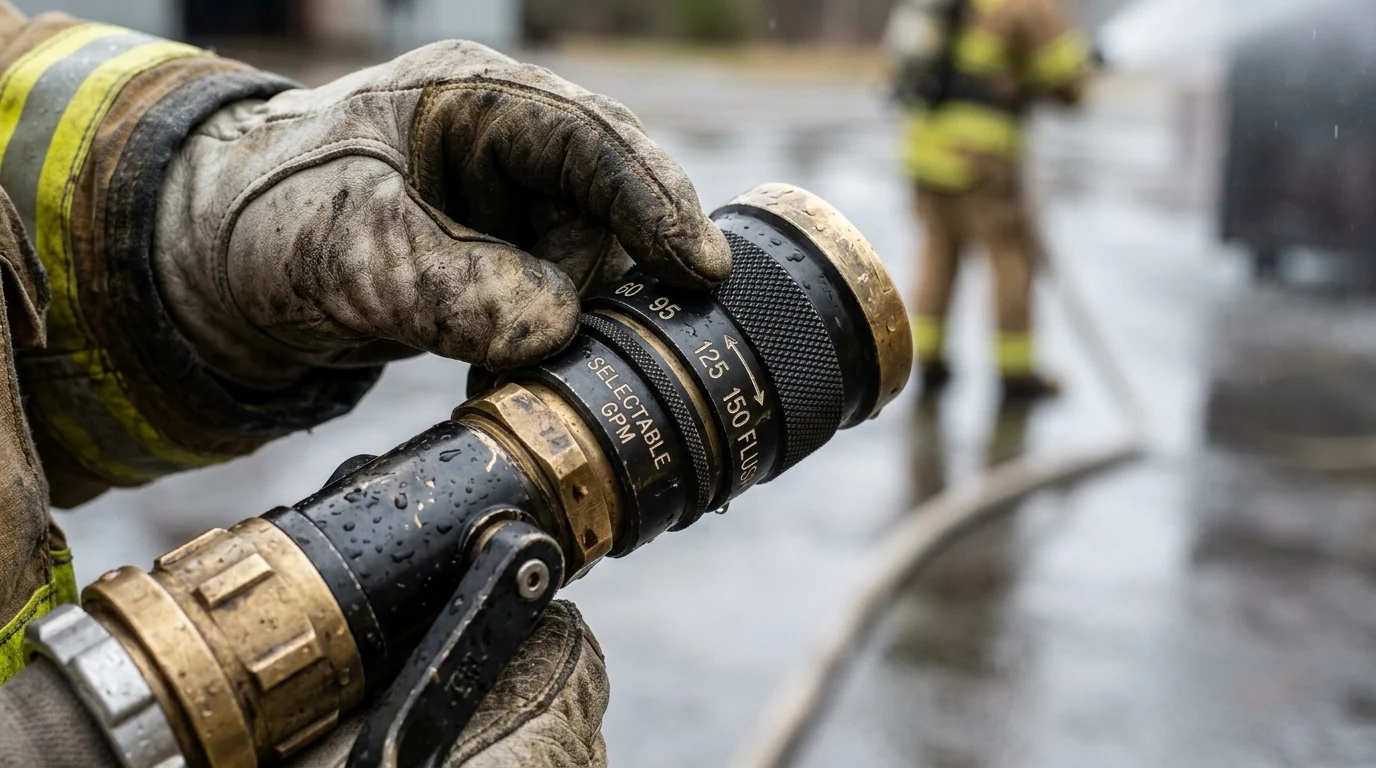
The operational environment strictly dictates the necessary volume, reach, and pattern of water application. Adjustable flow rate nozzles excel across diverse operational theaters because they eliminate the need to repeatedly swap hose lines or change out hardware when tactical requirements shift. From dense urban centers to remote wildland interfaces, these nozzles adapt to the hazard at hand.
Structural and transitional fire attack
In structural firefighting, the initial knockdown phase demands overwhelming cooling power. Standard operating guidelines typically dictate a minimum flow of 150 GPM for interior residential fires, scaling up to 200 GPM or more for commercial structures. Adjustable nozzles set to their maximum gallonage can deliver this critical mass of water, absorbing heat rapidly and disrupting the fire tetrahedron.
During a transitional attack—where water is applied from the exterior prior to interior entry—the nozzle operator must carefully manage the stream to avoid pushing fire or disrupting the thermal layer. An adjustable nozzle allows the operator to select a moderate flow rate (e.g., 125 GPM) and utilize a straight stream pattern to coat the ceiling of the fire room. Once the crew transitions to the interior, they can instantly dial up to 150 GPM for aggressive suppression and later dial down to 30 GPM for meticulous spot-cooling during overhaul.
Wildland, industrial, marine, and airport use
Beyond municipal structural fires, adjustable flow rate nozzles are indispensable in specialized environments. In wildland firefighting, water conservation is paramount. Crews often operate from Type 3 or Type 6 engines with limited tank capacities (typically 300 to 500 gallons). Setting an adjustable nozzle to 10 or 30 GPM allows firefighters to construct wet lines and extinguish brush fires over extended durations without prematurely exhausting their water supply.
Conversely, industrial and marine firefighting applications demand massive flow rates to suppress high-heat hydrocarbon fires and cool exposed infrastructure. Adjustable nozzles utilized in these settings—often attached to 2.5-inch handlines or portable monitors—can be dialed from 150 GPM up to 250 GPM or more. Furthermore, these environments frequently require the application of firefighting foam. Many adjustable nozzles are designed to be compatible with foam eductors, provided the nozzle’s selected flow rate precisely matches the eductor’s rated GPM to ensure proper aeration and expansion.
Lower-flow settings for rescue standby
Not all fire department responses involve active, free-burning fires. A significant percentage of calls require deploying a protective hose line for rescue standby. During vehicle extrications, hazardous materials incidents, or technical rescues, a charged hose line must be in place to protect victims and rescue personnel from potential vapor ignition or sudden flash fires.
In these standby scenarios, an adjustable nozzle set to a lower flow rate (e.g., 60 or 95 GPM) provides an optimal balance of protection and resource management. If a minor vapor ignition occurs, a wide fog pattern at 60 GPM is highly effective at vapor dispersion and personnel protection. Operating at this lower setting ensures that a standard 500-gallon engine tank can sustain the protective stream for over eight minutes of continuous flow, buying crucial time for rescue operations without requiring an immediate secondary water supply.
How to Compare Nozzle Options
Selecting the optimal adjustable flow rate nozzle requires balancing hydraulic physics, human factors, and institutional standard operating procedures. Procurement committees must rigorously evaluate how different models interact with their existing apparatus, pump capacities, and the physical capabilities of their personnel.
Flow range, pattern control, and durability
When comparing options, the available flow range is the first specification to scrutinize. A common configuration for a 1.75-inch handline nozzle includes settings of 30, 95, 125, 150, and 200 GPM. Decision-makers must ensure these detents align with their tactical needs. Pattern control is equally critical; high-quality nozzles offer a smooth transition from a tight, solid-like straight stream to a wide, 120-degree protective fog curtain, ideally achievable with a quarter-turn of the bumper.
Durability and material construction directly impact the lifecycle of the nozzle. Modern adjustable nozzles are predominantly machined from extruded 6061-T6 aluminum that has been hard-coat anodized to prevent corrosion and wear. This material choice keeps the nozzle weight manageable—typically between 3 to 4.5 pounds for a 1.5-inch inlet model. In contrast, older or specialized marine variants cast from brass offer superior saltwater corrosion resistance but can weigh upwards of 8 to 10 pounds, significantly increasing firefighter fatigue during prolonged operations.
Pump pressure and staffing trade-offs
The hydraulic relationship between pump pressure, flow rate, and nozzle reaction is the most critical trade-off in nozzle selection. Nozzle reaction—the backward force exerted on the firefighter—is calculated using the formula NR = 0.0505 × Q × √P (where Q is GPM and P is nozzle pressure). A nozzle flowing 200 GPM at a standard 100 psi operating pressure generates approximately 101 pounds of reaction force. Managing this force safely typically requires two to three trained firefighters on the line.
To mitigate staffing shortages, many departments are transitioning to low-pressure adjustable nozzles engineered to operate at 50 or 75 psi. Dialing the pressure down while maintaining a 150 GPM flow rate reduces the nozzle reaction to roughly 65 pounds (at 50 psi), a force that a single firefighter can comfortably manage. However, lowering the operating pressure inherently reduces the velocity of the water, which can negatively impact the stream’s reach, penetration through thermal updrafts, and the quality of the fog pattern.
Compatibility with existing hose systems
A nozzle cannot be evaluated in a vacuum; it must be perfectly paired with the department’s existing hose inventory. The friction loss characteristics of the hose dictate how hard the engine must pump to deliver the required pressure to the nozzle tip. Utilizing a high-flow setting (e.g., 200 GPM) on an adjustable nozzle attached to an older, high-friction 1.5-inch hose will result in excessive pump discharge pressures, potentially exceeding the burst rating of the hose or the capacity of the pump.
Departments must match the nozzle’s inlet diameter and maximum flow rating to the appropriate hose size. Typically, 1.5-inch and 1.75-inch hoses are paired with nozzles rated up to 200 GPM, while 2.5-inch hoses utilize nozzles capable of flowing 250 to 300 GPM. Additionally, thread compatibility is paramount. While National Standard Thread (NST) is common in the United States, regional variations like National Pipe Straight Hose (NPSH) or specific quick-connect Storz fittings require careful attention during the specification process to ensure seamless integration.
Key Specifications and Standards
The design, manufacturing, and performance of adjustable flow rate nozzles are heavily regulated by industry standards to ensure reliability under extreme thermal and physical stress. Understanding these specifications is essential for procurement officers, maintenance technicians, and training divisions to ensure legal compliance and operational safety.
Rated flow settings and pressure requirements
In North America, the primary governing standard for the manufacturing of these devices is NFPA 1964: Standard for Spray Nozzles. This standard strictly dictates the acceptable tolerances for rated flow settings. According to NFPA 1964, a nozzle must deliver its rated flow at its rated pressure with a tolerance of +10% to -0%. This means a nozzle set to 150 GPM at 100 psi is legally permitted to flow up to 165 GPM, but it must never flow less than 150 GPM, ensuring firefighters are never shortchanged on cooling capacity.
Pressure requirements also define nozzle categories. Traditional nozzles are rated at 100 psi, but the industry has seen a massive shift toward 75 psi and 50 psi low-pressure variants to reduce nozzle reaction. Procurement documents must explicitly state the desired base operating pressure, as a 50 psi nozzle supplied with 100 psi of pump pressure will flow significantly more water than its dial indicates, generating dangerous levels of reaction force and rapidly draining the water supply.
Materials, ergonomics, and maintenance needs
Beyond flow dynamics, standards dictate ergonomic and maintenance features. The shutoff valve—typically a horseshoe-style bale—must operate smoothly under maximum working pressure and must not inadvertently slam shut, which could cause a catastrophic water hammer event capable of bursting the hose. Materials must pass rigorous salt-spray corrosion tests and high-temperature exposure tests without losing functionality.
Maintenance features, specifically the “flush” setting, are vital for operational continuity. NFPA standards require that nozzles be capable of flushing debris that may enter the water stream from drafting operations or decaying municipal water mains. A compliant adjustable nozzle must feature a flush detent that allows particulate matter measuring at least 0.25 inches (1/4 inch) in diameter to pass through the baffle without requiring the nozzle to be shut down or disassembled.
Compliance and acceptance testing
Acceptance testing is the final barrier before a nozzle is placed into active service. While NFPA 1964 covers the manufacturer’s obligations, NFPA 1962: Standard for the Care, Use, Inspection, Service Testing, and Replacement of Fire Hose, Couplings, Nozzles, and Fire Hose Appliances governs the department’s responsibilities. Upon delivery, and annually thereafter, nozzles must undergo visual inspections and operational tests.
Compliance testing involves a hydrostatic pressure test where the nozzle valve is closed and subjected to a pressure of 300 psi to check for leaks or structural failure. Furthermore, departments must utilize calibrated flow meters and pitot gauges to verify that the nozzle actually flows its stated GPM at the various selector ring detents. Documenting these compliance tests is critical for liability protection and ISO (Insurance Services Office) rating evaluations.
| Standard / Metric | Evaluated Parameter | Required Threshold / Tolerance | Practical Implication for Fire Departments |
|---|---|---|---|
| NFPA 1964 Flow Accuracy | Actual GPM vs. Dial Setting | +10% / -0% of rated flow | Guarantees minimum required water delivery for safe interior fire attack. |
| Debris Clearance (Flush) | Particulate passage size | Minimum 0.25 inches (1/4 inch) | Prevents clogs from hydrant rust or drafting debris during active suppression. |
| Hydrostatic Integrity | Valve and body pressure limit | 300 psi without leakage/failure | Ensures the nozzle won’t burst under extreme pump surges or water hammer. |
| NFPA 1962 Testing | Service testing frequency | Annual inspection and flow test | Maintains legal compliance and ensures lifecycle reliability of the hardware. |
Decision Process for Fire Departments
Integrating adjustable flow rate nozzles into a fire department’s arsenal is not merely a purchasing decision; it is a strategic commitment that directly impacts tactical doctrine, training requirements, and overall fireground safety. Leadership must adopt a methodical decision process to ensure the selected hardware aligns with the community’s specific risk profile.
Map hazards and response profiles
The first step in the decision process is mapping the local hazard landscape and the department’s response profile. An urban department operating in a jurisdiction with a robust, high-pressure municipal hydrant system has the luxury of virtually unlimited water. For them, selecting high-flow capable nozzles (up to 200 GPM on handlines) maximizes knockdown power without the persistent fear of running dry.
Conversely, a rural department relying heavily on water tender shuttle operations faces a different reality. If a department’s primary water supply consists of 1000-gallon tenders and drafting from static sources, aggressive water conservation is mandatory. In this profile, the ability to dial a nozzle down to 30 or 60 GPM during overhaul or defensive exposures is a critical operational requirement, making adjustable flow nozzles the logical choice.
Validate performance through field testing
Theoretical specifications must be validated through rigorous field testing before full-scale procurement. Departments should request evaluation models from multiple manufacturers and conduct blind flow testing. Using an inline flow meter at the pump panel and a pitot gauge at the nozzle tip, training officers should measure the actual GPM, tip pressure, and friction loss across the specific hose brands the department currently uses.
Field testing should also evaluate human factors. Firefighters of varying sizes and strength levels should operate the nozzles at their maximum flow settings (e.g., 150 GPM at 75 psi) to assess the manageability of the nozzle reaction. Evaluators must gauge how easily the selector ring turns while wearing heavily insulated structural firefighting gloves, and whether the detents provide sufficient tactile feedback in zero-visibility environments to confirm the chosen flow rate.
Choose when adjustable flow adds value
Ultimately, leadership must choose when the versatility of adjustable flow adds genuine value and when it introduces unnecessary complexity. The inherent risk of a selectable-gallonage nozzle is the “jack of all trades, master of none” trap, where improper training leads to firefighters accidentally fighting a mature structural fire at a 60 GPM setting, resulting in rapid thermal degradation and potential flashover.
Adjustable flow rate nozzles deliver immense value to departments that invest heavily in training and discipline. If personnel are drilled relentlessly on confirming their flow settings prior to crossing the threshold, the tactical advantages of variable water application far outweigh the risks. By carefully matching nozzle specifications to local hazards, verifying hydraulic performance through testing, and committing to ongoing operator education, fire departments can maximize both suppression efficiency and personnel safety.
Key Takeaways
- Use higher settings such as 150 to 200 GPM for rapid interior knockdown, then reduce to 30 or 60 GPM during overhaul to limit water damage.
- Match the nozzle setting with the correct operating pressure, commonly 50, 75, or 100 psi, to maintain accurate flow and stream quality.
- Train nozzle operators to adjust the selector ring based on fire conditions, because pump pressure changes directly affect flow and reach on selectable nozzles.
- Choose adjustable flow nozzles for firegrounds where crews may need to shift quickly between offensive attack, defensive cooling, and low-flow conservation.
- Do not confuse selectable-gallonage nozzles with automatic nozzles, because they control flow through different mechanisms and require different pump coordination.
- Procurement teams should evaluate nozzle flow range, coupling compatibility, certification requirements, and supplier reliability before purchasing for industrial or municipal use.
Frequently Asked Questions
What is an adjustable flow rate nozzle?
It is a fire hose nozzle that lets the operator select different water flows, often by rotating a selector ring. Common selectable-gallonage settings include 30, 60, 95, 125, 150, and 200 GPM.
Which firefighting applications benefit most from adjustable flow nozzles?
They are especially useful for interior attack, overhaul, limited water supply operations, industrial fire protection, marine firefighting, and situations where crews must shift quickly between high-volume knockdown and lower-flow control.
How is a selectable-gallonage nozzle different from an automatic nozzle?
A selectable-gallonage nozzle fixes the orifice based on the chosen setting, while an automatic nozzle uses an internal mechanism to maintain relatively constant tip pressure as flow changes.
Can firefighters change flow rates without shutting down the hose line?
Yes. The key advantage is that the nozzle operator can adjust flow at the tip during operations, provided crews are trained and the pump operator supplies the correct pressure.
Do adjustable nozzles help reduce water damage?
Yes. After initial knockdown, operators can reduce flow for overhaul or cooling, limiting excess water application, runoff, and unnecessary property damage.

Post time: Jun-17-2026