

A straight stream is chosen for maximum reach, penetration, and control. This article explains what affects its effective range, how to evaluate performance, and how to select compatible equipment for building, industrial, marine, and vehicle fire protection.
What Is the Effective Range of a Straight Stream Fire Nozzle?
The effective range of a straight stream fire nozzle is the usable distance where the water stream remains coherent enough to hit the fire with meaningful force. It is not a fixed number, because nozzle pressure, flow rate, hose diameter, friction loss, and operator technique all change the result.
In fire protection practice, the term should be read as a performance range, not a marketing claim. OSHA’s fire protection rule for a hose line used as an extinguisher substitute requires a minimum hose stream range of 30 feet horizontally, which is a useful baseline for understanding minimum reach expectations in simple applications.
How a Straight Stream Fire Nozzle Works
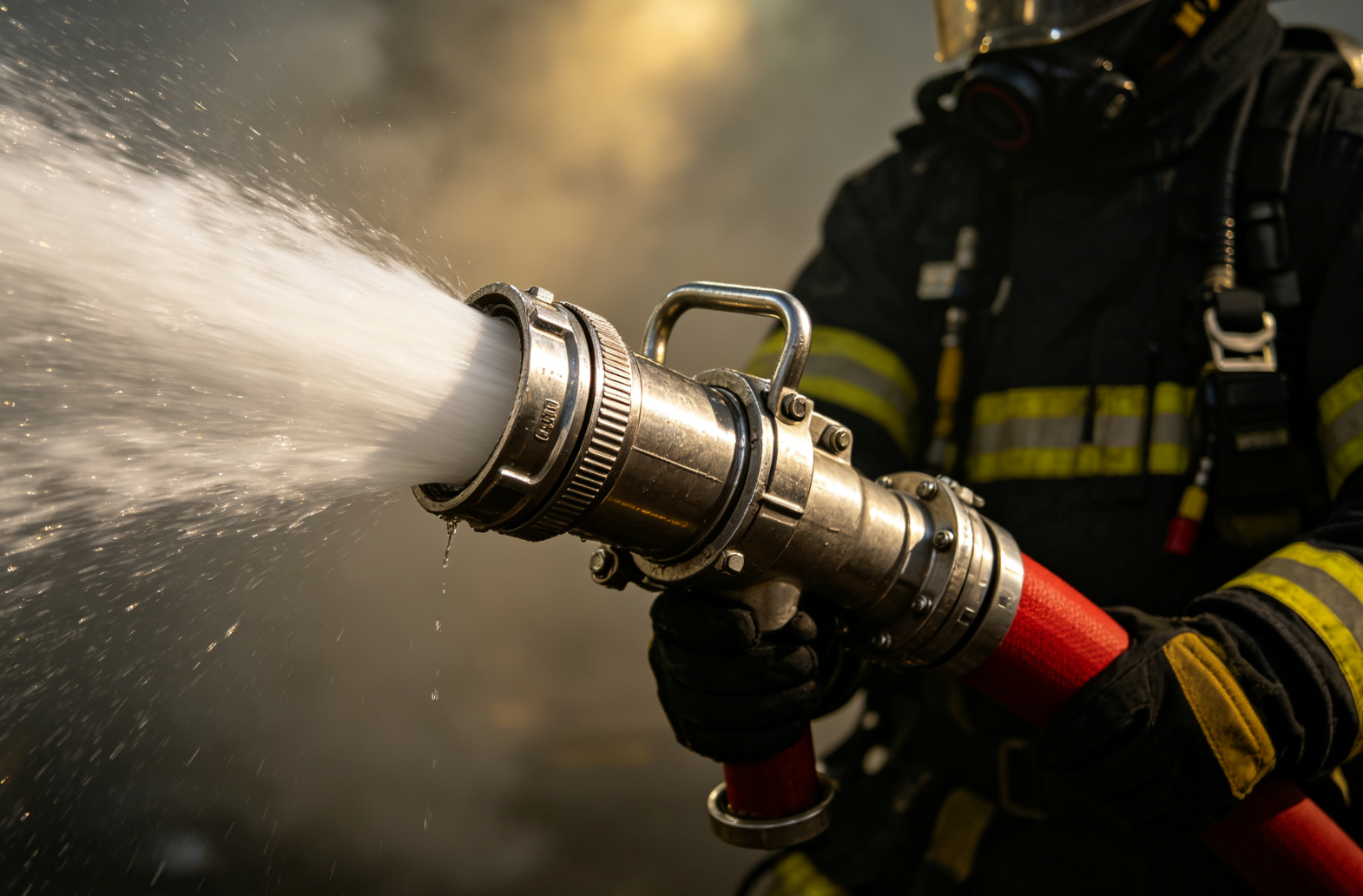
A straight stream fire nozzle produces a compact water column with limited breakup. That shape helps the stream travel farther, reduce wind drift, and deliver better penetration through heat and flame.
NWCG describes a straight stream nozzle as a hose tip designed to provide the maximum reach of water without feathering. That definition captures why this pattern is preferred when distance and directional control matter more than wide-area coverage.
Comparison Table: Straight Stream vs. Fog Pattern Performance
| Feature | Straight Stream | Fog Pattern |
|---|---|---|
| Reach | Longest usable distance | Shorter effective distance |
| Water shape | Compact, cohesive stream | Expanded droplets |
| Penetration | High | Lower |
| Cooling area | Narrower target zone | Broader coverage |
| Best use | Direct attack and distant targets | Exposure cooling and heat shielding |
What Factors Change Fire Nozzle Range?
The fire nozzle range depends on system pressure and flow more than on nozzle shape alone. A strong stream can still fail if the hose line is undersized, the pressure is too low, or the coupling and valve path create excessive loss.
NFPA 1964 covers spray nozzles and hose-connected appliances, including construction, test methods, and compliance testing. That standard matters because range is only useful when the nozzle performs consistently under recognized test conditions.
Key Specifications for Effective Stream Performance
| Factor | Why It Matters | Typical Effect on Range |
|---|---|---|
| Nozzle pressure | Drives stream cohesion and velocity | Higher pressure usually increases reach until losses appear |
| Flow rate | Controls delivered water volume | Too little flow weakens impact |
| Hose diameter | Influences friction loss | Smaller hose can reduce usable distance |
| Hose length | Adds resistance | Longer lines reduce pressure at the nozzle |
| Wind and heat | Break up the stream | Harsh conditions shorten effective range |
In marine applications, the nozzle and hose must also meet corrosion and installation demands. U.S. vessel rules require a nozzle capable of providing a solid stream and a spray pattern, which shows that range is only one part of overall firefighting performance.
How to Judge Whether the Range Is Sufficient
The correct range is the distance needed to reach the hazard with control, not the longest distance possible. A nozzle that throws farther but loses stability may be less useful than a shorter, more coherent stream.
For standpipe and hose systems, OSHA requires shut-off type nozzles and a minimum water supply of 100 gallons per minute for 30 minutes. That requirement highlights the link between range, flow, and system endurance rather than range alone.
- Use a straight stream when the target is distant, narrow, or partially shielded.
- Check whether the hose line can maintain pressure at the nozzle.
- Confirm that the stream remains compact under site conditions.
- Match the nozzle to the hose size, coupling standard, and expected flow.
Where Straight Stream Nozzles Fit in a Fire Protection System
A straight stream fire nozzle is only one part of a complete water delivery chain. Its performance depends on compatible valves, couplings, hose reels, and supply interfaces that keep pressure stable from source to discharge.
For buyers building a full system, the most relevant product groups are fire hydrant valve solutions, fire hose coupling products, and fire hose assemblies. These categories support the same operational goal: reliable water delivery with minimal compatibility risk.
World Fire Fighting Equipment structures its portfolio around five main groups: fire hydrant valves and water control, hose couplings and connectors, fire nozzles and discharge devices, hose reels and cabinets, and portable extinguishers. That product structure is useful for projects that need one supplier across the supply chain
Supplier Directory: Relevant Product Categories for Nozzle-Based Systems
- Fire hydrant valve and landing valve systems for controlled water supply.
- Fire hose coupling and adaptor products for interface compatibility.
- Fire nozzle and MED nozzle options for discharge control.
- Fire hose reel and cabinet products for first-response access.
- Portable extinguishers for complementary initial fire response.
How Procurement Teams Should Evaluate a Fire Hose Nozzle
A fire hose nozzle should be evaluated by compatibility, performance, and certification, not by appearance alone. Procurement teams should request the interface standard, working pressure range, flow data, and intended application before approving a purchase.
For B2B buyers, the most useful product pages are those that list material, interface type, pressure range, and scenario fit. That is especially important for export projects, OEM/ODM orders, and mixed-standard installations where a small mismatch can reduce effective range or delay commissioning.
When a project includes multiple regions or standards, adaptor and connector products become essential. They help bridge different coupling systems without changing the entire hose line, which can preserve performance while improving compatibility.
Selection Checklist for Straight Stream Fire Nozzle Use
- Confirm the target fire scenario and required reach.
- Match the nozzle to hose diameter and coupling standard.
- Verify pressure and flow at the operating point.
- Check certification and test documentation for the destination market.
- Inspect maintenance access, sealing condition, and wear points.
Maintenance and Inspection Affect Range More Than Many Buyers Expect
A straight stream fire nozzle loses effectiveness when internal wear, debris, or damaged seals disrupt flow. Even a well-designed nozzle can underperform if the hose line is poorly maintained or the cabinet prevents fast deployment.
OSHA requires hose reels and cabinets to facilitate prompt use and be clearly identified for fire equipment. That rule matters because delayed access often turns a technically adequate system into an operationally weak one.
Routine inspection should focus on nozzle movement, shutoff function, coupling integrity, and visible corrosion. In practice, these checks protect the stream pattern as much as they protect the hardware.
When a Straight Stream Is the Right Choice
A straight stream is the right choice when the fire is farther away, the target is concentrated, or wind makes a fog pattern unstable. It is also useful when firefighters need a more direct water path with less dispersion.
For building, industrial, and marine projects, the best results come from pairing the nozzle with a compatible supply system and documented standards. That approach improves both reach and reliability, which is the real measure of effective range.
FAQ
1. Is the effective range of a straight stream fire nozzle the same as its maximum throw distance?
The effective range is usually shorter than the maximum throw distance. It refers to the distance where the stream still performs usefully on the fire, with enough cohesion and impact to matter. Beyond that point, breakup, drift, and heat can reduce firefighting value.
2. Why does nozzle pressure matter so much for range?
Nozzle pressure helps keep the stream compact and fast enough to travel. If pressure is too low, the stream breaks apart sooner and loses reach. If the system has excessive friction loss, the nozzle may never receive the pressure needed for stable performance.
3. Can a straight stream be used on every fire?
No. It is best for direct attack and longer reach, but it is not ideal for every situation. Wide-area cooling, heat shielding, and exposure protection often benefit from other patterns. The correct choice depends on fire size, distance, and operating conditions.
4. What should buyers ask for when selecting a fire hose nozzle?
Buyers should ask for pressure rating, flow range, interface standard, material, certification, and intended application. These details help confirm compatibility with the hose line and the destination market. They also reduce the risk of poor performance after installation.
5. How often should a straight stream nozzle be inspected?
Inspection frequency depends on site policy and local code, but regular visual and functional checks are essential. Look for corrosion, debris, damaged seals, and shutoff problems. Any issue that affects flow or stream shape can reduce the nozzle’s effective range.

Post time: Jul-15-2026