

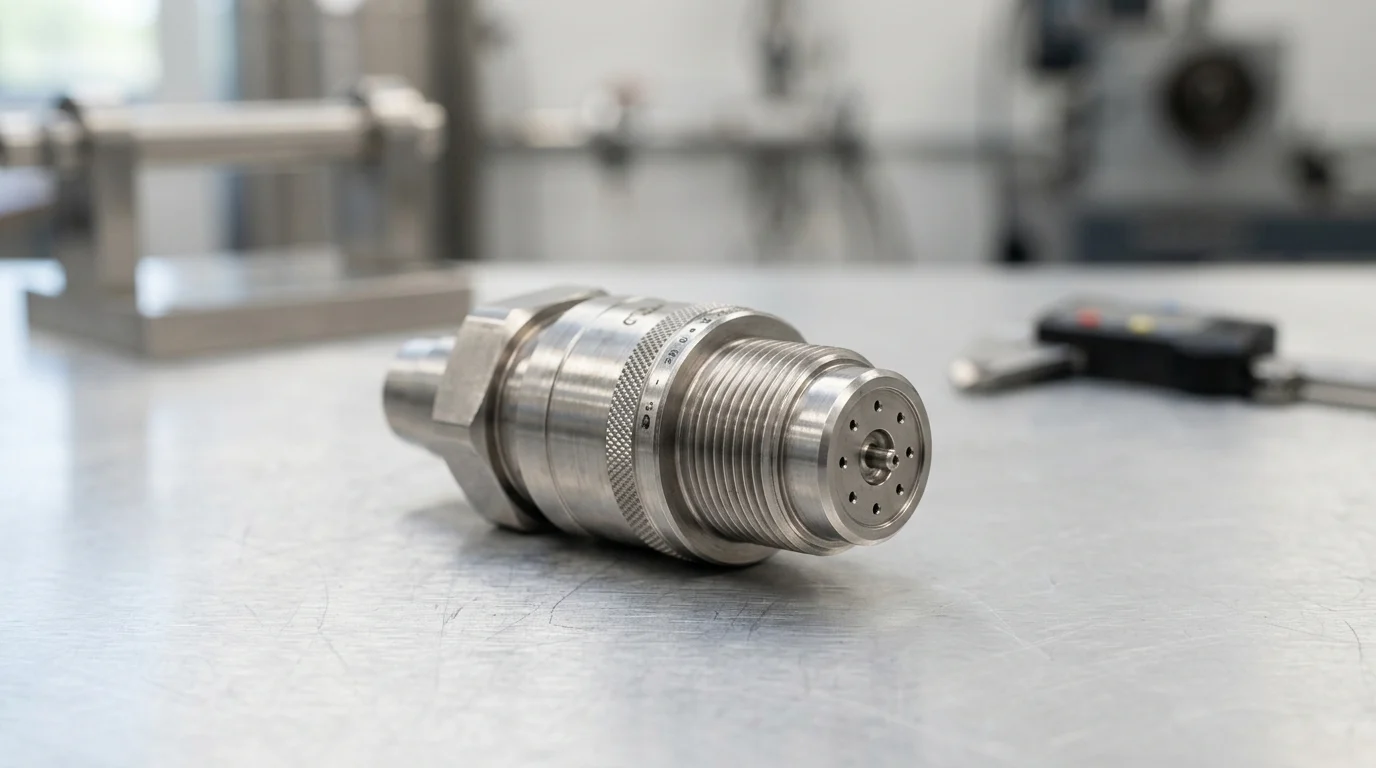
Why Fleet Operators Should Reassess MED Nozzles
Marine fire safety mandates absolute reliability, as vessel crews operate in isolated environments where external emergency response is rarely an immediate option. The transition from legacy fire suppression tools to modern, certified equipment is driven by increasingly stringent international maritime regulations and the growing complexity of onboard hazards. Fleet operators must continuously evaluate their safety inventory—particularly primary manual firefighting tools—to ensure optimal performance during critical incidents.
The regulatory landscape governing maritime safety is uncompromising, with the International Convention for the Safety of Life at Sea (SOLAS) and the Marine Equipment Directive (MED) establishing the baseline for operational readiness. Within this framework, the manual fire nozzle represents the critical interface between the vessel’s fire main infrastructure and the crew’s ability to suppress a blaze. Upgrading to MED-certified nozzles is no longer merely a compliance exercise; it is a strategic imperative to protect human life, safeguard high-value maritime assets, and ensure uninterrupted commercial operations.
Role of MED Nozzles in Fleet Fire Safety
MED nozzles are central to effective manual firefighting aboard commercial vessels. Operating as the terminal point of the fire main system, these specialized branch pipes dictate the velocity, flow rate, and droplet size of the extinguishing medium. Whether combating a Class A fire in a crew accommodation block or a volatile Class B hydrocarbon fire on a tanker deck, the nozzle must deliver a precise, adaptable spray pattern to achieve rapid thermal cooling and oxygen displacement.
Standard operational parameters for maritime environments require nozzles capable of delivering consistent flow rates, typically ranging between 200 and 500 liters per minute (LPM), at nominal operating pressures of 2 to 6 bar. MED-certified nozzles are engineered to maintain these critical flow dynamics regardless of fluctuations in the fire main pressure. By providing seamless transitions between a straight jet for deep penetration and a wide fog pattern for crew shielding, these nozzles empower seafarers to execute aggressive interior attacks and defensive boundary cooling with maximum efficacy.
Operational Risks of Outdated Fire Nozzles
Relying on outdated or non-certified fire nozzles presents severe operational risks that can compromise an entire vessel’s safety profile. Equipment manufactured from standard brass or lower-grade industrial alloys is highly susceptible to dezincification and galvanic corrosion when continuously exposed to salt-laden marine atmospheres. Over time, this metallurgical degradation leads to seized control mechanisms, obstructed waterways, and catastrophic structural failures during pressurized operation.
Industry reliability data indicates that non-compliant or legacy marine nozzles experience a failure rate increase of up to 40% over a standard five-year operational lifecycle compared to their certified counterparts. A seized flow control bail or a deformed baffle head can render a fire hose completely useless in the critical first three minutes of a fire emergency. Furthermore, outdated nozzles frequently lack the internal flushing capabilities necessary to clear marine growth, rust scale, or debris from the vessel’s fire main, creating a severe bottleneck exactly when maximum water delivery is required.
What Defines MED Nozzles
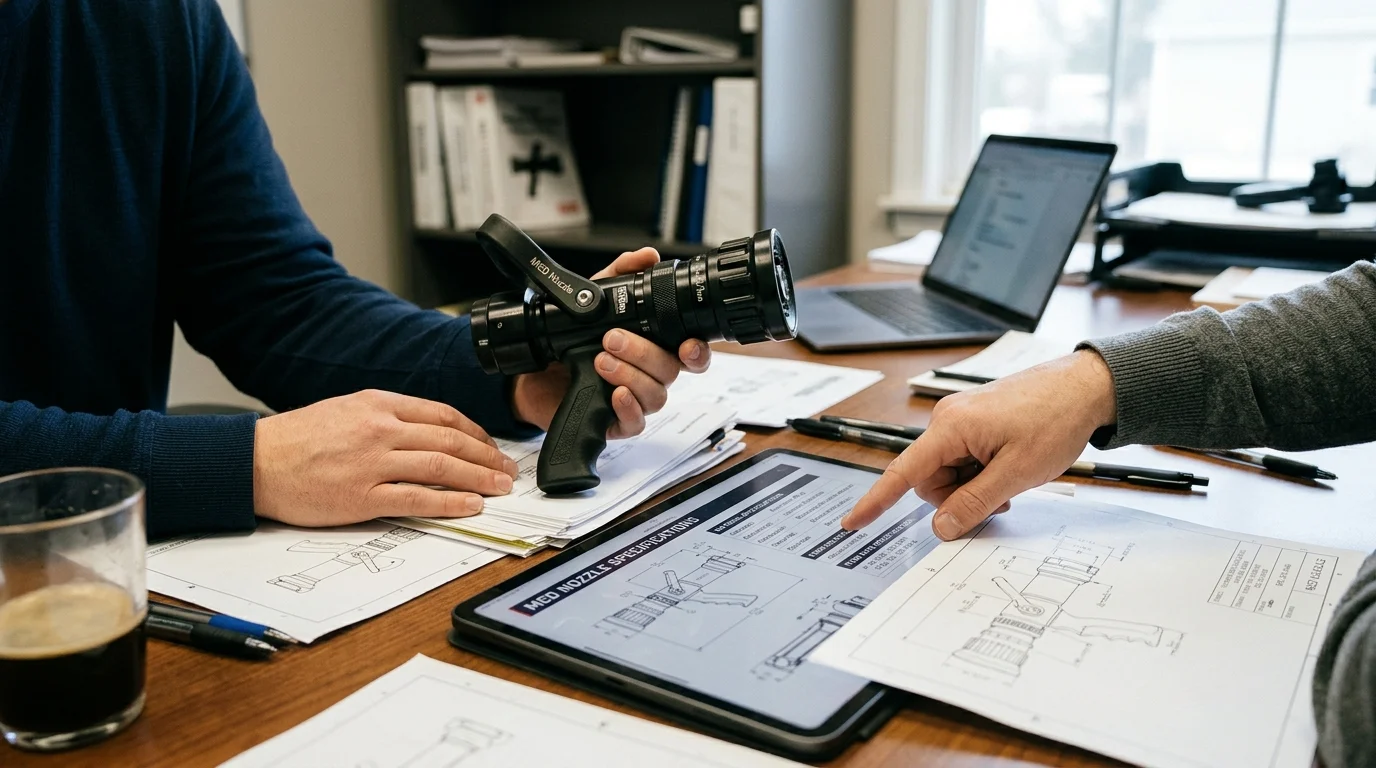
Understanding the technical and regulatory framework surrounding MED nozzles is essential for marine procurement officers and fleet safety superintendents. The Marine Equipment Directive (2014/90/EU) establishes a rigorous, standardized benchmark for equipment installed on European Union-flagged vessels—a standard that is universally recognized and frequently mandated by maritime authorities globally. Equipment that successfully meets these exhaustive testing criteria is awarded the distinctive “Wheelmark” insignia, certifying its compliance with international maritime safety conventions.
The Wheelmark is not merely a bureaucratic stamp; it is a guarantee of metallurgical integrity, hydraulic performance, and operational durability under the most extreme maritime conditions. Manufacturers of MED nozzles must submit their products to independent notified bodies for rigorous type-approval testing, followed by continuous production quality assurance audits. This dual-layered certification process ensures that every nozzle deployed on a vessel performs exactly to its published specifications.
Certification, Construction, and Flow Requirements
Certification of MED nozzles is primarily governed by the EN 15182 standard, which specifies the exact performance and testing criteria for hand-held branch pipes used by fire services. To achieve compliance, the construction materials must withstand extreme thermal shock, impact forces, and highly corrosive environments. Premium MED nozzles are typically machined from marine-grade hard-anodized aluminum alloys or 316L stainless steel, materials chosen for their exceptional strength-to-weight ratios and resistance to chloride-induced pitting.
Flow requirements mandate precise hydraulic tolerances to ensure predictable performance. A certified MED nozzle must maintain a stable, uniform spray angle—typically between 100 and 120 degrees for a wide fog pattern—to guarantee adequate radiant heat protection for the nozzle operator. In straight jet mode, the nozzle must achieve a cohesive throw range exceeding 12 meters at an operating pressure of 6 bar, ensuring that crews can apply cooling water from a safe standoff distance. Furthermore, the equipment must pass stringent hydrostatic pressure tests, often requiring the nozzle body to withstand internal pressures exceeding 40 bar without permanent deformation or leakage.
Key Differences From Standard Fire Nozzles
The divergence between standard commercial fire nozzles and MED-certified variants is substantial, encompassing material science, ergonomic design, and hydraulic engineering. While standard industrial nozzles may suffice for controlled onshore environments, they lack the specialized adaptations required for the chaotic and corrosive realities of the maritime sector. MED nozzles integrate features specifically designed for seafarers, who may not possess the daily operational familiarity of professional municipal firefighters.
To illustrate the critical distinctions, the following table compares the typical specifications of a standard industrial nozzle against a modern MED-certified marine nozzle:
| Specification Matrix | Standard Industrial Nozzle | Premium MED-Certified Nozzle |
|---|---|---|
| Primary Material | Standard Brass / Extruded Aluminum | Hard-Anodized Marine Aluminum / 316L SS |
| Testing Standard | Regional Industrial Codes | EN 15182 / MED 2014/90/EU (Wheelmark) |
| Saltwater Corrosion Resistance | Low to Moderate (3-5 year lifespan) | Exceptional (10-15 year lifespan) |
| Debris Flush Capacity | Rare / Requires Shutdown | Integrated (Passes up to 6mm debris) |
| Optimal Operating Pressure | 5 to 7 bar | 2 to 6 bar (Optimized for ship fire mains) |
| Weight Profile | 3.5 kg to 5.0 kg | 1.5 kg to 2.2 kg |
These differences highlight why MED nozzles are exclusively suited for fleet deployment. The integration of high-flow debris flushing and low-pressure optimization ensures that the nozzle remains functional even if the vessel’s primary fire pumps are operating at diminished capacity or if the fire main is contaminated with marine biofouling.
How MED Nozzles Improve Compliance and Readiness
The deployment of MED nozzles directly correlates with elevated fleet readiness and seamless regulatory compliance. When Port State Control (PSC) inspectors board a vessel, fire safety equipment is subjected to immediate and uncompromising scrutiny. The presence of Wheelmark-certified equipment provides inspectors with immediate visual confirmation that the vessel operator is committed to maintaining the highest echelons of maritime safety.
Beyond avoiding administrative penalties, the true value of MED nozzles is realized in the hands of the crew during a crisis. The intersection of ergonomic design, robust durability, and intuitive operation dramatically reduces the cognitive and physical load on seafarers during a fire response. Upgrading to these advanced systems ensures that the vessel’s primary manual defense mechanism is always primed for immediate, effective deployment.
Support for Marine Equipment Directive Compliance
Support for MED compliance actively mitigates the severe financial and operational risks associated with vessel detentions. Fire safety deficiencies consistently rank among the top three reasons for PSC detentions globally, particularly under the rigorous enforcement regimes of the Paris and Tokyo Memorandums of Understanding (MoU). Inspectors routinely test fire main pressures and inspect branch pipes; any sign of corrosion, seizing, or lack of proper certification can trigger an immediate deficiency report.
The financial implications of non-compliance are staggering. Fines for critical fire safety violations can range from €5,000 to €50,000 depending on the jurisdiction. More critically, the catastrophic daily costs of an immobilized, detained commercial vessel often exceed $20,000 to $50,000 per day in lost charter revenue and port fees. By equipping a fleet exclusively with MED-certified nozzles, operators establish a standardized, universally accepted compliance baseline that expedites port turnarounds and insulates the company from costly regulatory interruptions.
Crew Usability, Durability, and Response Speed
Usability and durability are critical factors that directly influence response speed during an active fire emergency. Modern MED nozzles feature ergonomic pistol grips and intuitive, oversized flow control bails designed specifically for operation by personnel wearing heavy, insulated firefighting gloves. The tactile feedback of these controls ensures that crew members can quickly select the appropriate flow rate and spray pattern even in zero-visibility, smoke-filled environments.
Weight reduction represents a massive leap forward in crew readiness. Utilizing advanced marine-grade alloys reduces the unit weight from approximately 4.5 kg in legacy brass models to roughly 1.8 kg in modern MED configurations. This 60% reduction in weight sharply decreases crew fatigue, allowing personnel to maneuver charged hose lines up steep companionways and through narrow bulkheads with far greater speed and agility. Additionally, the integrated flush settings—capable of passing particulate matter up to 6mm in diameter without shutting down the water supply—ensure that response speed is never hindered by unexpected fire main blockages.
Cost, Sourcing, and Lifecycle Trade-Offs
Upgrading an entire fleet’s manual firefighting inventory involves significant capital expenditure, necessitating a rigorous financial and logistical analysis. Procurement officers must look beyond the initial purchase order and evaluate the lifecycle economics of their fire safety infrastructure. Balancing immediate unit costs against long-term operational value is essential for building a sustainable, cost-effective safety procurement strategy.
A fleet-wide upgrade is not merely a purchasing event; it is a strategic transition that impacts maintenance schedules, inventory management, and vessel downtime. By conducting thorough audits of existing equipment and understanding the Total Cost of Ownership (TCO) of MED-certified gear, fleet operators can optimize their capital outlays while simultaneously upgrading their risk management profile.
Comparing Unit Cost With Long-Term Value
Comparing unit cost with long-term value requires a comprehensive TCO perspective that accounts for replacement frequency, maintenance labor, and failure risks. A standard industrial fire nozzle may carry an attractive initial unit cost of $150 to $300. In contrast, a premium MED-certified marine nozzle typically commands a price band of $400 to $900, depending on the flow specifications and material composition. However, this initial premium is rapidly offset by the extended lifecycle of the certified equipment.
The Mean Time Between Failures (MTBF) for MED-certified nozzles extends to 10 to 15 years in harsh saltwater environments, provided routine fresh-water flushing is performed. Conversely, uncertified commercial equivalents typically exhibit a functional lifespan of merely 3 to 5 years before galvanic corrosion or mechanical seizing necessitates replacement. When factoring in the logistical costs of delivering replacement parts to vessels operating globally, the higher upfront cost of the MED nozzle yields a significantly lower lifecycle expenditure.
Auditing Current Fleet Fire Equipment
Auditing current fleet fire equipment is the critical first step in executing a strategic upgrade. Superintendents must evaluate the hydrostatic test dates, perform visual inspections for zinc depletion (dezincification), and test the mechanical action of all moving parts under pressure. Any nozzle exhibiting stiff actuation, weeping seals, or degraded baffle teeth should be flagged for immediate replacement.
To quantify the financial impact of an upgrade, the following table models the 10-Year Total Cost of Ownership for a single commercial vessel requiring an inventory of 20 fire nozzles:
| Cost Component (10-Year Horizon, 20 Units) | Standard Uncertified Nozzles | MED-Certified Nozzles |
|---|---|---|
| Initial Procurement Cost | $4,000 ($200/unit) | $12,000 ($600/unit) |
| Replacement Cycles Required | 2 additional cycles (Years 4 & 8) | 0 additional cycles |
| Cost of Replacement Units | $8,800 (assuming 10% inflation) | $0 |
| Estimated Maintenance & Spares | $2,500 | $800 |
| Logistics/Freight for Replacements | $1,800 | $0 |
| Total 10-Year TCO per Vessel | $17,100 | $12,800 |
This financial model demonstrates that while the MED-certified nozzles require a capital outlay three times higher at inception, they generate a net savings of over $4,300 per vessel over a ten-year operational window. Multiplied across a fleet of 30 or 50 vessels, the long-term capital efficiency becomes undeniably compelling.
How to Prioritize a Fleet Upgrade
Executing a fleet-wide upgrade requires a systematic, risk-based approach to procurement and installation. Rather than attempting a simultaneous, disruptive overhaul across all maritime assets, operators typically phase the deployment of MED nozzles based on specific risk matrices, vessel operational schedules, and dry-docking availability. This strategic phasing ensures that capital is deployed efficiently and that the most critical vulnerabilities are addressed first.
To secure executive approval and budget allocation, safety superintendents must construct a robust business case that aligns maritime safety improvements with tangible corporate financial goals. By identifying the correct vessels to prioritize and leveraging the cascading benefits of superior safety equipment, fleet managers can transition their fire safety infrastructure smoothly and cost-effectively.
Vessels, Routes, and Risk Profiles to Prioritize
Prioritization should focus heavily on high-risk vessels where the probability and potential severity of fire incidents are elevated. Roll-on/Roll-off (Ro-Ro) passenger ferries, crude oil tankers, and chemical carriers must be at the vanguard of the upgrade schedule. On these vessels, the presence of densely packed vehicles, lithium-ion battery risks, or volatile cargo necessitates the immediate availability of high-performance, fault-tolerant firefighting equipment. Upgrading these assets first delivers the highest immediate reduction in catastrophic risk.
Furthermore, operators must analyze their global routing profiles. Vessels deployed on routes that intersect with the most stringent PSC jurisdictions—such as North American ports under the US Coast Guard, or European ports governed by the Paris MoU—should be prioritized for MED nozzle upgrades. Ensuring that vessels operating in these high-scrutiny zones are equipped with flawless, Wheelmark-certified gear prevents costly operational delays and protects the fleet’s overall compliance scoring.
Building the Business Case for MED Nozzles
Building the business case for MED nozzles involves quantifying risk reduction and capturing secondary financial benefits. Beyond avoiding direct regulatory fines and detention costs, upgrading to Wheelmark-certified equipment can positively influence insurance underwriting. Marine insurers rigorously assess the onboard safety culture and equipment standards; operators demonstrating proactive, fleet-wide safety upgrades can frequently negotiate premium reductions of 2% to 5% on their Protection and Indemnity (P&I) or Hull and Machinery (H&M) coverage.
Finally, fleet-wide procurement strategies should be structured to leverage economies of scale. By consolidating the upgrade into scheduled, bulk purchasing agreements, procurement teams can negotiate highly favorable terms with marine safety manufacturers. Minimum Order Quantities (MOQs) of 50 or more units typically unlock volume discounts ranging from 10% to 15% off standard marine retail pricing. By combining these bulk discounts with the long-term TCO savings and potential insurance rebates, the transition to MED nozzles transforms from a compliance mandate into a financially astute operational upgrade.
Key Takeaways
- Audit fleet fire nozzles regularly to confirm they meet MED and SOLAS-related expectations for vessel readiness.
- Prioritize MED-certified nozzles that deliver stable flow in the typical 200 to 500 LPM range at 2 to 6 bar operating pressure.
- Replace corroded, seized, or non-certified nozzles before they compromise the first critical minutes of an onboard fire response.
- Select nozzles with reliable straight jet and fog pattern control so crews can perform direct attack, cooling, and shielding tasks effectively.
- Work with certified manufacturers such as NBWorldFire to source marine fire equipment that fits global B2B procurement, compliance, and budget requirements.
Frequently Asked Questions
What are MED nozzles used for on vessels?
MED nozzles are manual firefighting nozzles fitted to a vessel’s fire main system. They control water flow, jet reach, fog pattern, and spray coverage so crews can respond to accommodation, machinery, deck, and hydrocarbon fire risks.
Why should fleet operators replace outdated fire nozzles?
Older or non-certified nozzles may corrode, seize, clog, or fail under pressure in marine environments. Upgrading reduces operational risk, improves crew response, and helps vessels stay aligned with SOLAS and MED expectations.
What flow rates are typical for marine fire nozzles?
Marine fire nozzles commonly operate around 200 to 500 LPM at nominal pressures of 2 to 6 bar, depending on vessel requirements and system design. The nozzle must maintain stable performance despite fire main pressure changes.
How do MED-certified nozzles improve crew safety?
They allow crews to switch between straight jet and fog patterns, supporting direct attack, boundary cooling, and personnel shielding. Reliable controls and corrosion-resistant construction are especially important when crews must act without immediate external emergency support.
Are MED nozzles only about regulatory compliance?
No. Compliance is important, but MED nozzles also support faster fire suppression, lower equipment failure risk, better asset protection, and fewer operational disruptions across commercial fleets.

Post time: Jun-24-2026