

Introduction
Choosing the right setting on an adjustable flow rate nozzle is more than a comfort issue—it directly affects reach, cooling capacity, steam production, and firefighter safety. Different fire classes and changing fire conditions demand different flow rates, pressures, and stream patterns, so a nozzle that is set too low or too high can reduce suppression effectiveness and increase risk. This article explains how to match nozzle adjustment to the type of fire, available water supply, and tactical objective, while also showing how nozzle operators and pump operators must coordinate to keep the line performing as intended.
Why Adjustable Flow Rate Nozzle Selection and Adjustment Matter
The deployment of an adjustable flow rate nozzle represents a critical tactical decision in modern fire suppression. By allowing operators to manually select the gallon-per-minute (gpm) discharge, these devices offer unparalleled versatility across diverse fire classes. Standard operating pressures for these nozzles typically include 50, 75, and 100 psi, demanding precise coordination between the nozzle operator and the pump operator to ensure optimal water delivery and thermal management.
How fire conditions change required flow
Modern fire environments are characterized by rapid heat release rates (HRR) driven by the prevalence of synthetic materials. A contemporary residential compartment fire can easily exceed an HRR of 20 megawatts (MW). To overcome this immense thermal energy, the suppression flow rate must match or exceed the British Thermal Units (BTUs) being generated by the combustion process.
An adjustable flow rate nozzle allows the attack team to dynamically scale the flow. As conditions deteriorate, operators can shift from a baseline of 95 gpm to 150 gpm or 200 gpm without shutting down the line. This ensures the water application rate remains sufficient to achieve rapid cooling and knockdown in escalating fire conditions.
Why incorrect settings increase risk
Failing to select the appropriate flow setting introduces severe operational risks. If the nozzle is under-set for the fire’s intensity, the water droplets will vaporize before penetrating the thermal column, failing to cool the seat of the fire and potentially pushing steam back toward the attack crew.
Conversely, over-setting the flow rate unnecessarily depletes finite water supplies. Discharging at 200 gpm will drain a standard 500-gallon apparatus tank in merely 2.5 minutes if an established municipal water supply is not yet secured. Furthermore, excessive flow rates generate disproportionate nozzle reaction forces. Flowing 200 gpm at 100 psi generates approximately 100 pounds of backward thrust, which accelerates firefighter fatigue, compromises stream control, and increases the risk of musculoskeletal injuries.
Operating Principles of an Adjustable Flow Rate Nozzle
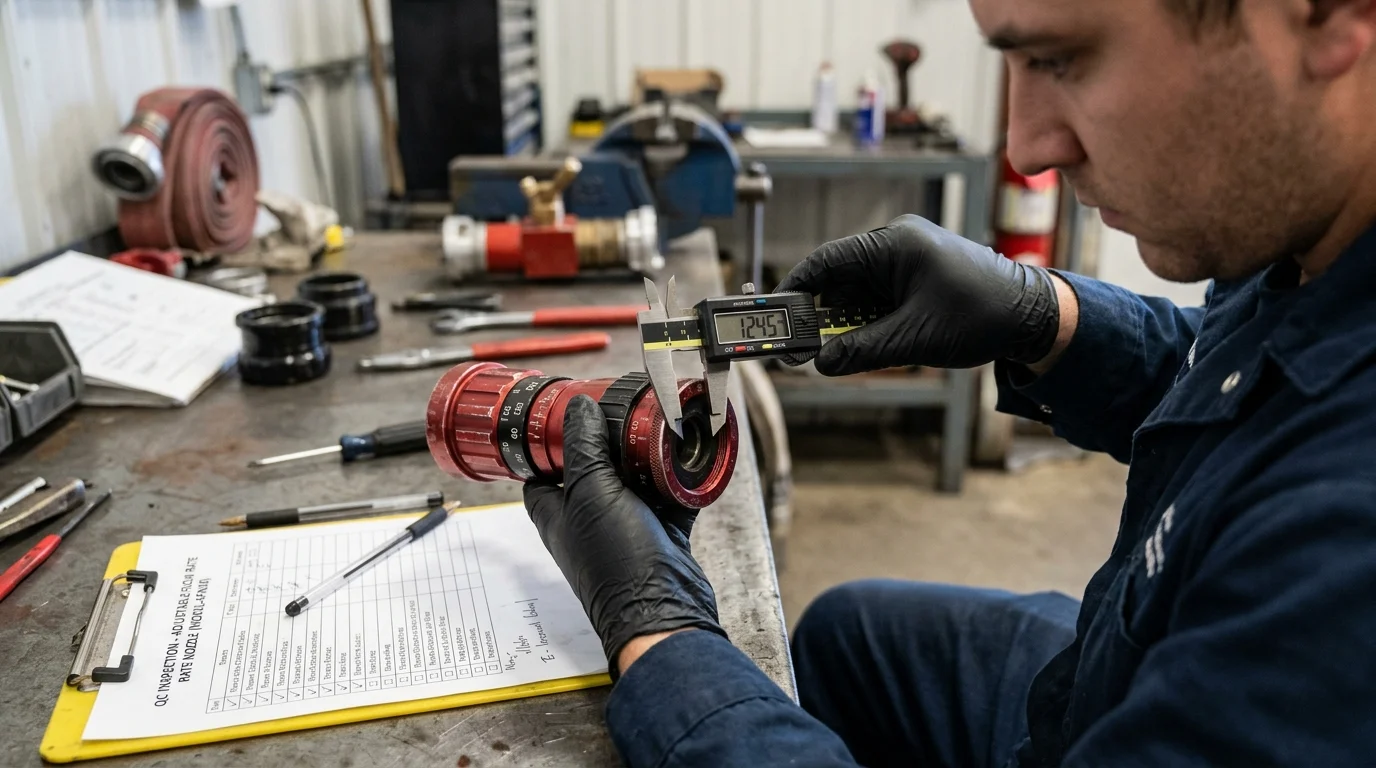
The efficacy of an adjustable flow rate nozzle is rooted in fluid dynamics and precise mechanical engineering. These devices manage hydraulic energy by altering the discharge orifice size while attempting to maintain an optimal operating pressure, thereby ensuring stream reach and droplet integrity remain consistent across different volume settings.
Nozzle mechanics behind selectable flow settings
The internal mechanics rely on a rotating selector ring that adjusts the position of a spring-loaded baffle or opens specific internal water ports. As the operator rotates the ring to a higher gpm setting, the internal aperture widens, allowing a greater volume of water to pass through without requiring a proportional increase in pump discharge pressure.
| Flow Setting (gpm) | Operating Pressure (psi) | Nozzle Reaction (lbs) | Optimal Hose Diameter (inches) |
|---|---|---|---|
| 30 | 100 | 15 | 1.00 |
| 95 | 100 | 48 | 1.50 |
| 150 | 75 | 65 | 1.75 |
| 200 | 75 | 87 | 2.50 |
This precise mechanical calibration ensures that the aerodynamic profile of the water stream remains intact, whether the operator is discharging a low-volume protective fog or a high-volume solid stream for deep penetration.
How fire conditions translate into nozzle settings
Fire conditions dictate not only the volume of water required but also the pattern of application. The adjustable flow rate nozzle translates these requirements through its pattern selection bumper. A narrow 30-degree fog pattern maximizes the surface area of the water droplets for rapid heat absorption in a superheated compartment, while a straight stream setting maximizes kinetic energy to penetrate deep-seated Class A materials.
Adjusting the pattern and flow simultaneously allows the stream to achieve an effective reach of 50 to 80 feet, depending on wind conditions and pump pressure. This reach is critical for bridging the gap between safe tactical positioning and the active combustion zone, ensuring water reaches the target without exposing personnel to extreme radiant heat.
How to Adjust an Adjustable Flow Rate Nozzle
Properly adjusting an adjustable flow rate nozzle requires a systematic approach that aligns the mechanical settings of the device with the hydraulic capabilities of the pumping apparatus. This synergy ensures the selected flow rate is accurately and safely delivered to the nozzle tip.
Step-by-step pressure and flow verification
The adjustment process begins with precise flow verification. The nozzle operator selects the desired flow rate using the calibrated ring, ensuring it clicks securely into the detent to prevent accidental mid-operation shifts due to vibration or impacts.
Once selected, the pump operator must calculate and set the Engine Discharge Pressure (EDP). This requires factoring in the nozzle’s rated pressure (e.g., 75 psi) plus the friction loss of the specific hose lay. For example, pushing 150 gpm through 200 feet of 1.75-inch hose typically generates approximately 65 psi of friction loss, requiring an EDP of 140 psi to achieve the target flow at the nozzle tip.
Adjustment priorities for structural Class A fires
When addressing structural Class A fires, flow rate adjustments must prioritize thermal dominance. The National Fire Academy (NFA) fire flow formula dictates that the required gpm equals the area of involvement divided by three. For a standard 1,200-square-foot residential floor plan with 50% involvement, the baseline requirement is 200 gpm.
Consequently, operators must bypass lower granular settings and adjust the nozzle directly to the 150 or 200 gpm detent before making interior entry. This proactive adjustment ensures the initial attack possesses the necessary cooling capacity to halt fire propagation and protect the structural integrity of the compartment.
Recommended flow settings by scenario
Tactical scenarios demand specific baseline settings to optimize water usage and suppression efficiency. For exterior defensive operations or heavy fire loads, maximum settings of 200 to 250 gpm are recommended to deliver maximum kinetic impact and cooling.
During interior offensive attacks on standard residential fires, a setting of 150 gpm provides an ideal balance of knockdown power and manageable nozzle reaction. For overhaul operations, where the objective is extinguishing smoldering embers, adjusting down to 30 or 60 gpm prevents unnecessary water damage and conserves resources. Vehicle fires generally require intermediate settings between 95 and 125 gpm to overcome the intense localized heat of burning plastics and magnesium components.
Technical, Compliance, and Training Factors
The deployment of adjustable flow rate nozzles is strictly governed by industry standards and rigorous maintenance protocols. Adherence to these technical and compliance factors is mandatory to guarantee the equipment performs reliably under extreme thermal and mechanical stress.
NFPA-aligned practices, pump capacity, and hose considerations
The National Fire Protection Association (NFPA) 1964 standard serves as the primary compliance benchmark for spray nozzles. Under this standard, an adjustable flow rate nozzle must deliver within +10% to -0% of its rated capacity at the specified operating pressure. This ensures predictable hydraulic performance on the fireground.
Pump capacity and hose selections must align with these parameters. A pump rated for 1,250 gpm can theoretically support six 200-gpm attack lines, provided the hose diameters are sufficient to minimize friction loss. Utilizing a 1.5-inch hose for a 200-gpm setting will result in excessive friction loss, often exceeding 50 psi per 100 feet, which risks over-pressurizing the pump apparatus and bursting the hose line.
Maintenance, calibration, and operator training
Maintaining the tight tolerances of an adjustable flow rate nozzle requires a strict calibration and testing schedule. Departments must conduct annual hydrostatic testing, typically subjecting the nozzle to 300 psi for a duration of one minute to verify the integrity of the internal seals and the baffle mechanism.
Furthermore, operator training must emphasize tactile familiarity and gross motor skills. Firefighters should be required to demonstrate the ability to adjust flow settings and pattern controls within 3 seconds while wearing NFPA-compliant structural firefighting gloves, ensuring crucial muscle memory is established for zero-visibility, high-stress environments.
How Buyers and Operators Should Choose Adjustable Flow Rate Nozzles
Procuring the correct adjustable flow rate nozzle requires balancing tactical requirements, apparatus specifications, and municipal budgets. A well-maintained, high-quality nozzle boasts an operational lifespan of 10 to 15 years, making the initial specification process a critical long-term investment for any agency.
Decision criteria for department needs
Decision-makers must evaluate several core criteria when outfitting a department. Ergonomics and weight are paramount; modern hard-coat anodized aluminum nozzles typically weigh under 4.5 pounds for 1.5-inch inlet models, significantly reducing operator fatigue compared to legacy cast brass models.
Additionally, departments must assess the lead times for replacement parts, such as spinning teeth or bumper rings, which frequently sustain impact damage. Cost is a major determining factor, with premium adjustable nozzles generally ranging from $600 to $1,200 per unit depending on the flow range, material quality, and integrated features like slide valves or integral smooth bore options.
How to guide apparatus and nozzle specification choices
Apparatus specification choices must directly inform nozzle selection. If a department primarily operates rapid intervention vehicles with limited 300-gallon water tanks, high-flow nozzles may be counterproductive. Instead, models with granular lower-end settings (e.g., 15-30-50 gpm) are necessary to extend operational time before a water supply is secured.
| Nozzle Classification | Flow Control Mechanism | Pressure Management | Primary Tactical Advantage | Estimated Cost Band (USD) |
|---|---|---|---|---|
| Adjustable Flow | Manual selector ring | Fixed operating pressure | Operator dictates precise water volume | $600 – $1,200 |
| Automatic Flow | Spring-regulated baffle | Dynamic pressure regulation | Maintains stream reach despite pump fluctuations | $800 – $1,500 |
| Fixed Gallonage | Static orifice | Fixed operating pressure | Simplicity and minimal training required | $400 – $800 |
By cross-referencing these technical specifications with the department’s standard operating guidelines (SOGs) and typical staffing levels, buyers can ensure the selected adjustable flow rate nozzles enhance both firefighter safety and suppression efficacy.
Key Takeaways
- The most important conclusions and rationale for Adjustable Flow Rate Nozzle
- Specs, compliance, and risk checks worth validating before you commit
- Practical next steps and caveats readers can apply immediately
Frequently Asked Questions
How do I choose the right flow setting for different fire classes?
Use straight stream and higher flow for deep-seated Class A, fog for heat control, and only approved agents for Class B or energized Class C. Match nozzle setting to SOPs and pump capacity.
What flow rate should I start with on an adjustable flow rate nozzle?
Begin with the department-approved baseline, often around 95 gpm, then increase as heat release and fire growth demand. Confirm the pump can maintain the nozzle’s rated operating pressure.
How can I avoid excessive nozzle reaction when increasing flow?
Step up flow gradually, use proper stance and hose support, and coordinate with the pump operator. Higher settings like 150–200 gpm create much more backward thrust and fatigue.
Why is pump pressure important when adjusting the nozzle?
Selectable flow works correctly only at the nozzle’s rated pressure, such as 75 or 100 psi. If pressure is too low, reach and stream quality drop; too high increases reaction and water waste.
What should buyers check when sourcing adjustable flow rate nozzles from NBWorldFire?
Verify flow range, operating pressure, pattern control, material durability, and market certifications needed for your project. For global B2B procurement, match the nozzle to hose size, application, and compliance requirements.
Post time: May-26-2026