

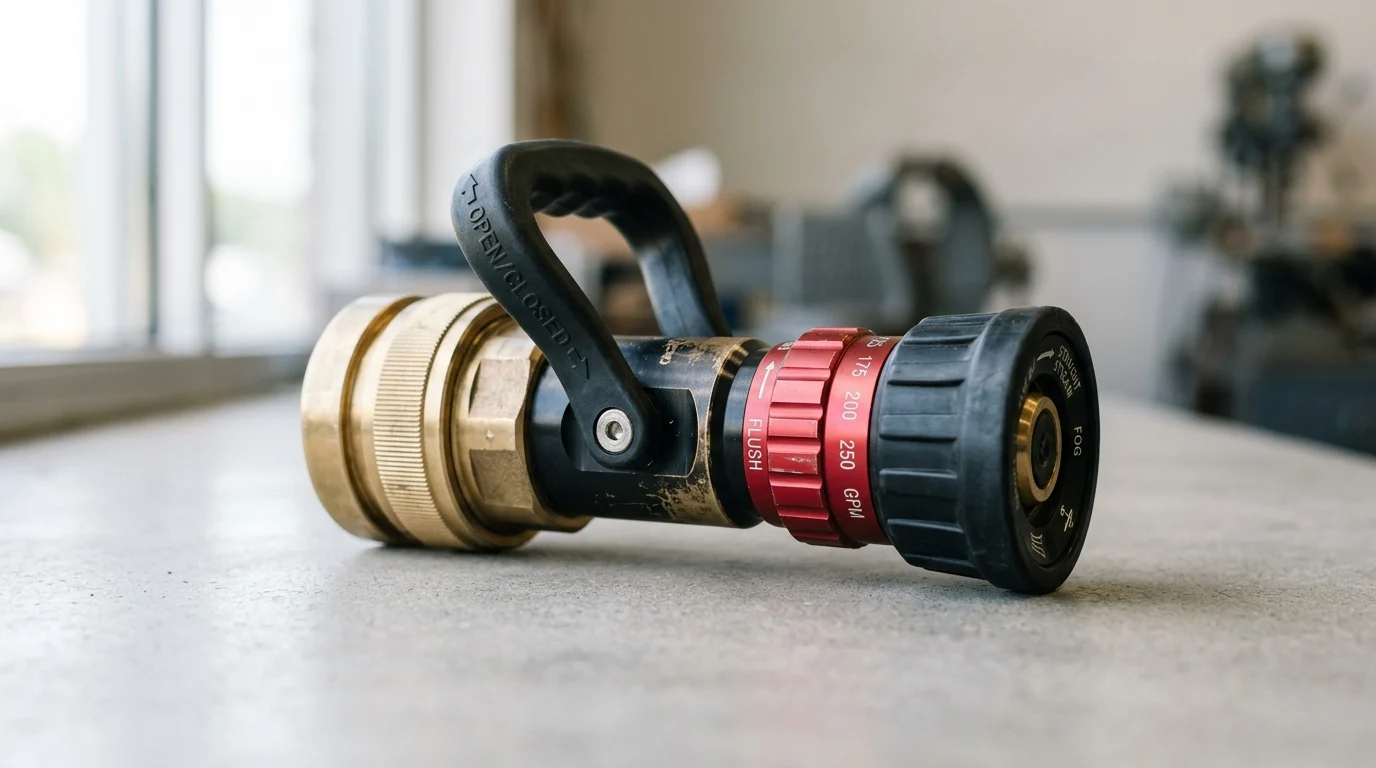
Start with Vessel Fire Scenarios
Marine fire protection relies on a carefully balanced hydraulic system, where the fire water nozzle serves as the critical delivery point. Selecting the correct nozzle requires more than matching coupling threads; it demands a comprehensive understanding of the vessel’s specific fire scenarios. Failing to align the nozzle’s output characteristics with the fire pump’s capacity can result in inadequate throw distances, insufficient cooling, or unmanageable reaction forces for the crew.
Map likely onboard fire risks
Identifying the specific fire risks across different vessel zones is the foundational step in nozzle selection. A machinery space presents a high risk for Class B (flammable liquid) fires, requiring rapid heat absorption and boundary cooling. In contrast, accommodation areas primarily pose Class A (combustible solid) risks, where deep-seated fire penetration is the primary concern. Cargo holds may present mixed risks depending on the manifest, necessitating versatile suppression tactics.
Marine engineers must quantify these risks into actionable performance metrics. For instance, a localized lube oil fire in the engine room may demand a dense water fog pattern at 400 to 500 liters per minute (LPM) to effectively smother the flames without scattering the fuel. Conversely, a fire on the weather deck involving containerized cargo might require a solid jet stream capable of penetrating high-velocity crosswinds.
Define required flow, pressure, and throw
Once the risks are mapped, operators must define the exact flow rate, operating pressure, and throw distance required to mitigate them. Throw distance is a critical safety parameter, determining how close the crew must approach a thermal hazard. A standard requirement for cargo hold fires is an effective jet reach of at least 15 to 20 meters, allowing firefighters to maintain a safe standoff distance while directing water onto the seat of the fire.
Pressure and flow operate in tandem to achieve this throw. A fire water nozzle requires a minimum kinetic energy at the tip to shape the water stream effectively. While regulatory minimums provide a baseline, optimal performance often requires targeting a nozzle pressure of 3.5 to 5.0 bar. If the pressure falls below the nozzle’s design threshold, the stream will break apart prematurely, severely compromising both reach and droplet size in fog patterns.
Match nozzle needs to marine fire pump capacity
The defined nozzle requirements must then be cross-referenced against the actual capacity of the vessel’s marine fire pump. A common structural error is deploying high-flow nozzles on a system driven by a low-capacity pump. If a vessel is equipped with a primary fire pump rated for 120 cubic meters per hour (m³/hr) at an 8-bar discharge pressure, the total available flow is roughly 2,000 LPM.
This total capacity must supply multiple hydrants simultaneously during a major incident. If standard operating procedures dictate the use of four nozzles concurrently, the maximum allowable flow per nozzle cannot exceed 500 LPM without causing a catastrophic pressure drop across the entire fire main. Matching the nozzle to the pump ensures that deploying additional attack lines does not starve the initial attack crews of essential water pressure.
Calculate Flow and Pressure Requirements
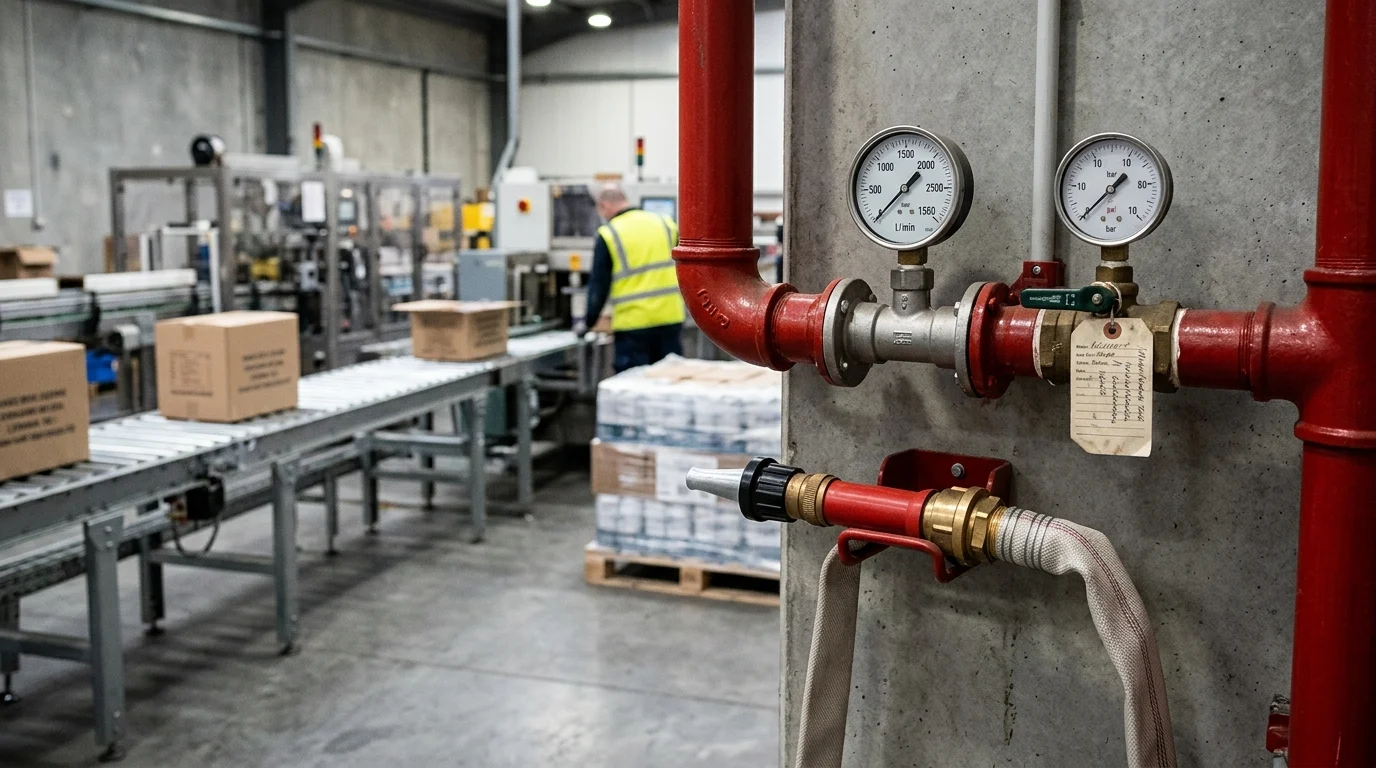
Establishing the theoretical match between a fire water nozzle and the fire pump requires rigorous hydraulic calculations. The pressure delivered at the pump discharge flange is never the pressure available at the nozzle tip. Naval architects and marine engineers must account for the complex network of piping, valves, and hoses that consume hydraulic energy before the water reaches the operator.
Read pump curves and available pressure
The evaluation begins with the fire pump’s performance curve, which plots total dynamic head (pressure) against volumetric flow rate. Centrifugal pumps, standard in marine applications, exhibit a drooping curve where discharge pressure decreases as flow demand increases. Operators must identify the specific operating point on this curve that corresponds to the anticipated fire main demand.
For example, a marine fire pump might be rated to deliver 100 m³/hr at a head of 80 meters (approximately 7.8 bar). However, if the crew opens additional hydrants and pushes the demand to 130 m³/hr, the available head may drop to 60 meters (5.8 bar). Fire water nozzle specifications must be evaluated against this degraded pressure state, representing the worst-case hydraulic scenario during a multi-line attack.
Account for hose friction and elevation loss
As water travels from the fire main through the lay flat hose to the nozzle, it encounters friction, which dissipates pressure. The rate of friction loss is determined by the hose diameter, the internal lining material, and the velocity of the water. Smaller diameter hoses moving high volumes of water generate exponentially higher friction losses, severely limiting the pressure available at the nozzle.
Elevation changes further complicate available pressure. Supplying a fire water nozzle on the bridge deck from a pump located in the lower engine room introduces significant vertical lift losses, calculated at approximately 0.1 bar per meter of elevation.
| Hose Diameter (mm) | Flow Rate (LPM) | Approx. Friction Loss per 10m (bar) | Optimal Application |
|---|---|---|---|
| 38 mm (1.5″) | 250 | 0.25 | Interior accommodation spaces |
| 45 mm (1.75″) | 400 | 0.18 | Rapid deployment, mixed spaces |
| 65 mm (2.5″) | 500 | 0.08 | Weather deck, heavy boundary cooling |
Identify under-supplied nozzle conditions
Failing to account for these cumulative losses leads to under-supplied nozzle conditions. An under-supplied fire water nozzle is a severe tactical liability. For instance, an automatic nozzle designed to maintain a 7-bar operating pressure will mechanically restrict its baffle if supplied with only 3 bar, drastically reducing the flow rate to maintain stream shape.
In fixed-flow nozzles, low pressure results in a flaccid stream that cannot penetrate thermal updrafts. Engineers must calculate the total pressure loss from the pump to the furthest and highest hydrant, subtract the hose friction loss, and verify that the residual pressure meets the nozzle’s minimum operating specification. If the residual pressure is insufficient, the vessel must either utilize lower-flow nozzles or upgrade the fire main pump capacity.
Choose the Right Fire Water Nozzle Type
With the hydraulic boundaries defined by the pump and piping system, selecting the specific type of fire water nozzle involves evaluating mechanical functionality and tactical versatility. The marine industry utilizes several distinct nozzle architectures, each engineered to interact differently with the available flow and pressure.
Compare fixed-flow, selectable-flow, automatic, fog, and jet nozzles
The primary categories of modern marine nozzles include fixed-flow, selectable-flow, and automatic variants. Fixed-flow nozzles are mechanically simple, delivering a specific volume of water at a specific pressure (e.g., 400 LPM at 5 bar). They are highly reliable due to a lack of internal moving parts, making them ideal for harsh marine environments where maintenance may be deferred.
Selectable-flow nozzles feature a rotating dial that allows the operator to manually adjust the orifice size, typically offering settings such as 115, 230, 360, and 475 LPM. This provides tactical flexibility, allowing crews to conserve water during overhaul or maximize flow during initial knockdown. Automatic nozzles utilize an internal spring-loaded baffle that adjusts dynamically to fluctuating supply pressures, maintaining a constant tip pressure to ensure a consistent stream reach even if the pump output drops.
| Nozzle Type | Flow Control Mechanism | Pressure Dependency | Best Marine Use Case |
|---|---|---|---|
| Fixed-Flow | Static orifice | Highly dependent on pump | Standard crew deployment, low maintenance |
| Selectable-Flow | Manual dial adjustment | Operator must match to pressure | Specialized fire teams, variable risks |
| Automatic | Spring-loaded baffle | Self-regulating (within limits) | Systems with fluctuating fire main pressures |
Evaluate flow range, pattern control, and reach
Beyond flow control, pattern manipulation is critical. Dual-purpose nozzles that can seamlessly transition between a solid straight stream (jet) and a wide-angle fog pattern are standard in maritime operations. The straight stream provides maximum kinetic energy and reach, often capable of penetrating 30 meters to strike remote cargo fires.
The fog pattern, conversely, is utilized for heat absorption and personnel protection. A high-quality fire water nozzle should be capable of producing a dense, uniform 120-degree water curtain. This wide fog pattern acts as a radiant heat shield, allowing the firefighting team to advance down narrow companionways or approach isolation valves in the engine room without sustaining thermal injuries.
Check materials, couplings, and corrosion resistance
The marine environment is aggressively corrosive, making material selection just as important as hydraulic performance. Standard aluminum nozzles used in municipal firefighting will rapidly oxidize and seize when exposed to saltwater spray and humid sea air. Marine-grade nozzles must be constructed from corrosion-resistant alloys such as gunmetal, bronze, or hard-anodized aluminum with stainless steel internal components.
Furthermore, the nozzle must integrate seamlessly with the vessel’s specific coupling standards. International shipping relies on a fractured landscape of coupling designs, including Storz, Nakajima, Machino, and John Morris (Instantaneous). Specifying a nozzle with the incorrect coupling type, or relying on heavy brass adapters, introduces potential failure points and delays during emergency deployment. Direct-machined couplings of the correct standard are highly recommended.
Verify Compliance and Installation Fit
Procurement of firefighting equipment in the maritime sector is strictly governed by international conventions and classification society rules. A fire water nozzle must not only fit the physical and hydraulic profile of the vessel but also carry the appropriate type approvals to ensure statutory compliance.
Review SOLAS, flag-state, and class requirements
The International Convention for the Safety of Life at Sea (SOLAS) Chapter II-2 dictates the foundational requirements for marine fire mains and nozzles. SOLAS mandates that vessels must be capable of delivering at least two jets of water simultaneously to any part of the ship. To achieve this, the regulations specify standard nozzle sizes, typically 12mm, 16mm, or 19mm, depending on the space being protected.
For accommodation and service spaces, nozzle sizes need not exceed 12mm, as the primary goal is maneuverability and controlling Class A fires without excessive water damage. In machinery spaces and exterior locations, sizes of 16mm or 19mm are required to deliver the higher flow rates necessary for boundary cooling and Class B fire suppression. Dual-purpose (spray/jet) nozzles are mandatory, ensuring crews have access to both reach and heat shielding.
Confirm hose diameter, hydrant spacing, and coupling compatibility
Compliance also extends to the integration between the fire water nozzle, the hose, and the hydrant. SOLAS requires specific minimum pressures to be maintained at the hydrants when two pumps are operating simultaneously. For cargo vessels over 6,000 gross tonnage, the minimum pressure at the hydrant is 2.7 bar for machinery and cargo spaces, and 2.0 bar for other spaces.
While minimums are heavily regulated, maximum pressures are equally critical. Classification societies typically limit maximum hydrant pressure to 7.0 bar. Pressures exceeding this threshold create severe safety hazards, as the reaction force of the nozzle becomes unmanageable for a single operator, and the risk of hose burst increases dramatically. Pressure-reducing valves must be installed on hydrants where the static pump pressure exceeds these safe operating limits.
Plan inspection, flushing, spares, and crew drills
Installation fit encompasses the lifecycle management of the equipment. A compliant fire water nozzle is useless if it is seized shut from salt accumulation or internal marine growth. Maintenance plans must include regular flushing of the fire main with fresh water, particularly after the system has been pressurized with seawater during drills or testing.
Class surveyors will inspect nozzles during annual safety equipment surveys, checking for smooth operation of the pattern selector and shutoff valve. Vessels must carry a mandated number of spare nozzles and hoses, properly stowed in designated, clearly marked fire lockers. Crew drills must incorporate the actual deployment and pressurization of these nozzles to ensure personnel are familiar with the specific reaction forces and spray patterns of the onboard equipment.
Make the Final Nozzle Selection
The final selection of a fire water nozzle represents a synthesis of technical data, regulatory mandates, and practical usability. The goal is to equip the vessel with a durable, compliant tool that maximizes the fire pump’s potential without overwhelming the crew operating the hose line.
Use a decision matrix for hydraulic fit and usability
Marine superintendents and safety officers should employ a decision matrix to finalize procurement. This matrix must weight hydraulic compatibility heavily—specifically, how well the nozzle’s optimal operating pressure aligns with the fire main’s residual pressure. However, usability factors are equally vital. A highly complex automatic nozzle may offer superior hydraulic performance on paper, but if the vessel operates with a frequently rotating crew lacking specialized training, a rugged fixed-flow nozzle may provide greater operational reliability.
The matrix should also account for lifecycle costs, factoring in the durability of materials like gunmetal versus the lighter weight and lower initial cost of anodized aluminum. Heavily trafficked vessels, such as ferries or offshore support vessels, may prioritize impact resistance, opting for nozzles with heavy-duty rubber bumper rings to survive frequent drops on steel decks.
Decide when higher-capacity nozzles are justified
While standard 12mm to 19mm handline nozzles suffice for general cargo and passenger vessels, specialized tonnage often justifies higher-capacity equipment. Chemical tankers, liquid natural gas (LNG) carriers, and vessels with helicopter landing decks face extreme thermal threats that require massive water application rates for cooling and foam generation.
In these scenarios, high-capacity nozzles exceeding 600 LPM are deployed. However, operators must carefully manage the physics of such equipment. A fire water nozzle discharging 600 LPM at 5 bar generates a reaction force exceeding 250 Newtons. Industry safety standards generally dictate that any reaction force above 250 Newtons requires at least two trained operators to safely manage the hose line. If the vessel’s crewing levels cannot support multi-person hose teams, portable monitors must be utilized instead of hand-held high-capacity nozzles.
Validate performance through onboard testing
The procurement process does not end with the delivery of the equipment; the theoretical calculations must be validated through practical onboard testing. During commissioning or after a major drydock refit, the newly matched nozzles and fire pumps should undergo comprehensive flow testing.
Engineers utilize inline flow meters and handheld pitot gauges to measure the actual discharge pressure and flow rate at the nozzle tip. This testing confirms whether the required 15 to 20-meter throw distance is achieved under real-world conditions, accounting for the actual condition of the vessel’s piping rather than theoretical friction loss charts. Only through this physical validation can operators be certain that their fire water nozzle and marine fire pump will perform as a cohesive, life-saving system during an emergency.
Key Takeaways
- Map vessel fire risks by zone before selecting a fire water nozzle, because machinery spaces, accommodations, cargo holds, and decks require different flow patterns and tactics.
- Target a nozzle pressure of about 3.5 to 5.0 bar where appropriate to preserve stream shape, fog quality, and usable throw distance.
- For cargo hold or weather deck risks, verify that the selected nozzle can achieve an effective reach of about 15 to 20 meters.
- Calculate available flow per nozzle by dividing pump capacity by the number of hose lines expected to operate simultaneously.
- Avoid installing high-flow nozzles on low-capacity systems, as excessive demand can collapse fire main pressure and weaken every connected line.
- Use certified, marine-suitable nozzles and compatible fire protection components to support regulatory compliance and reliable onboard response.
Frequently Asked Questions
How do I size a fire water nozzle for a vessel fire pump?
Start with the pump’s rated flow and discharge pressure, then divide usable flow by the number of nozzles expected to operate at once. For example, a 120 m³/hr pump provides about 2,000 LPM, so four simultaneous nozzles should each stay near 500 LPM or less.
What nozzle pressure is typically needed for effective marine firefighting?
Many marine applications target about 3.5 to 5.0 bar at the nozzle to maintain throw, stream quality, and fog pattern performance. Pressure below the nozzle’s design range can shorten reach and create unstable droplets.
Why is throw distance important when selecting a fire water nozzle?
Throw distance determines how far the crew can stand from heat, smoke, or cargo hazards while still applying water effectively. Cargo hold or deck fires may require an effective jet reach of 15 to 20 meters.
Can a high-flow nozzle reduce firefighting performance?
Yes. If the nozzle demands more flow than the pump and fire main can supply, system pressure drops. This can weaken all connected hose lines, reduce reach, and make fog or jet streams ineffective.
Which nozzle pattern is best for machinery space fires?
Machinery spaces with flammable liquid risks often need a dense fog pattern for heat absorption and cooling. The nozzle should deliver enough flow, commonly around 400 to 500 LPM for localized risks, without scattering burning fuel.

Post time: Jun-23-2026