

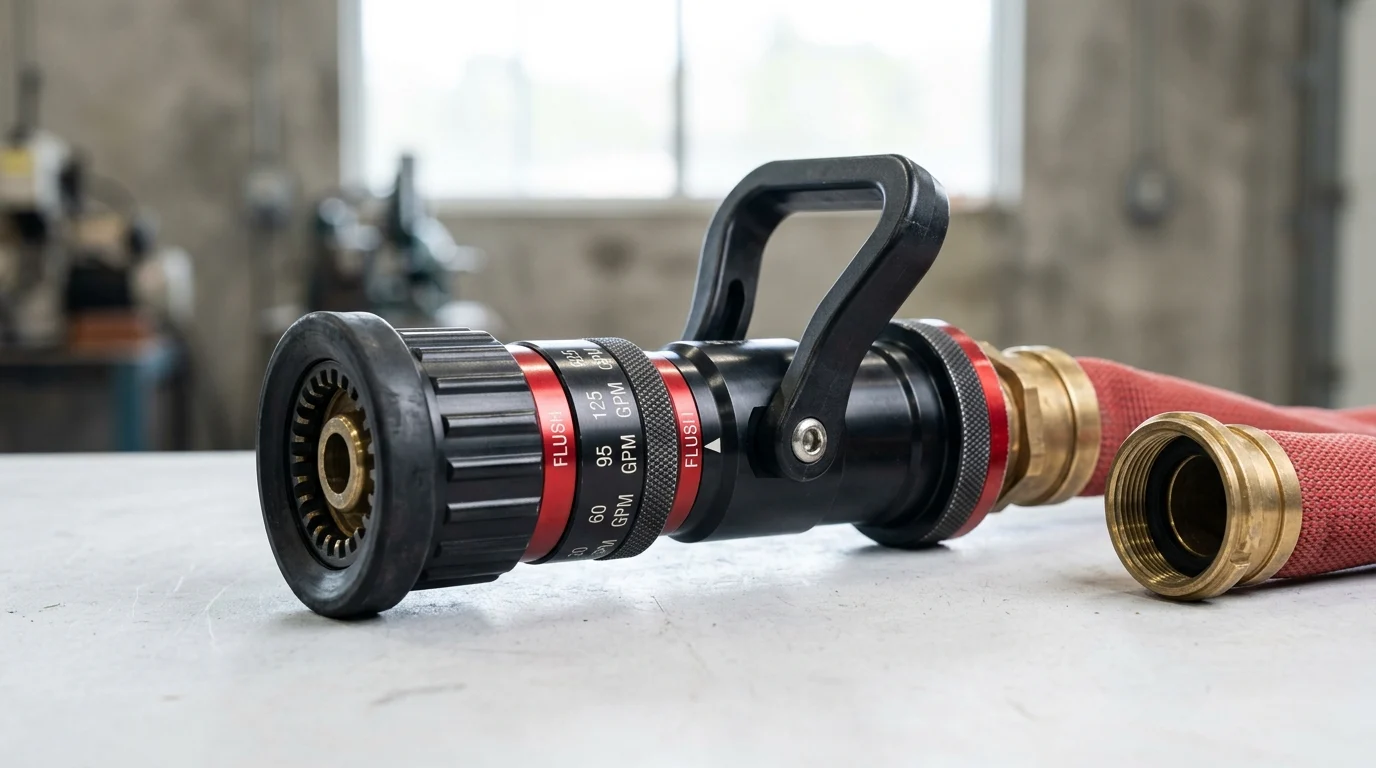
Why Adjustable Flow Rate Fire Nozzles Matter
Industrial fire protection relies on precision, adaptability, and highly reliable water delivery systems to mitigate catastrophic losses. Adjustable flow rate fire nozzles serve as critical instruments in this ecosystem, allowing operators to manually dictate the volume of extinguishing agent discharged without requiring the shutdown of the hose line. To evaluate their benefits, it is helpful to distinguish them from other nozzle categories early on: while fixed-flow nozzles deliver a single set volume and automatic nozzles dynamically adjust their internal baffle to maintain a constant pressure, manually adjustable (selectable gallonage) nozzles keep flow decisions entirely in the hands of the operator.
Unlike their fixed-orifice counterparts, these specialized nozzles feature a selectable gallonage ring, typically offering discrete settings ranging from 30 to 125 Gallons Per Minute (GPM) for standard handlines, or 95 to 250 GPM for larger industrial applications. High-volume industrial master stream variants can even scale up to 350 GPM or more. This mechanical flexibility ensures that suppression teams can continuously match the water application rate to the specific British Thermal Unit (BTU) output of a fire. By doing so, operators optimize suppression efficacy while simultaneously conserving critical suppression agent reserves, making these nozzles indispensable in complex industrial hazard zones.
Tactical advantages in changing fire conditions
Dynamic and immediate responses are essential when confronting volatile industrial hazards. Environments such as chemical processing plants, refineries, or bulk storage facilities present complex fires that can rapidly change in intensity, fuel involvement, and scope. An adjustable flow rate fire nozzle empowers the operator to dial up the flow rate from a conservative 95 GPM during initial exterior boundary cooling to a maximum 250 GPM when aggressive interior attack, heavy vapor mitigation, or foam application is required.
This real-time adaptability prevents the need for response personnel to retreat, shut down the water supply, and swap hose lines, thereby saving critical minutes during the highly volatile incipient and growth phases of a fire. Furthermore, the ability to throttle down the flow rate is equally advantageous during the overhaul phase. Lowering the GPM prevents excessive water accumulation, reduces operator fatigue, and allows for precise hotspot targeting without disrupting the thermal balance of the environment.
Operational and commercial risk reduction
Mitigating financial and environmental exposure is a primary driver for adopting selectable gallonage technology in the private sector. In high-value industrial facilities, water damage to sensitive machinery, electrical switchgear, and raw material inventories can often exceed the financial impact of the thermal event itself. By utilizing adjustable flow rate fire nozzles, emergency response teams can reduce unnecessary water discharge by an estimated 15% to 30% (based on manufacturer and industry benchmarks) during the containment and overhaul phases.
This precise flow reduction directly correlates to a decrease in contaminated runoff, which represents a major environmental liability and regulatory compliance issue in the petrochemical and manufacturing sectors. Treating thousands of gallons of chemically contaminated water incurs massive commercial costs. Additionally, limiting excess water usage preserves fixed water tank supplies—which are often capped between 5,000 and 10,000 gallons in typical remote industrial installations—ensuring that sufficient suppression capabilities remain available in the event of secondary ignitions or prolonged containment operations.
Key Features of Adjustable Flow Rate Fire Nozzles
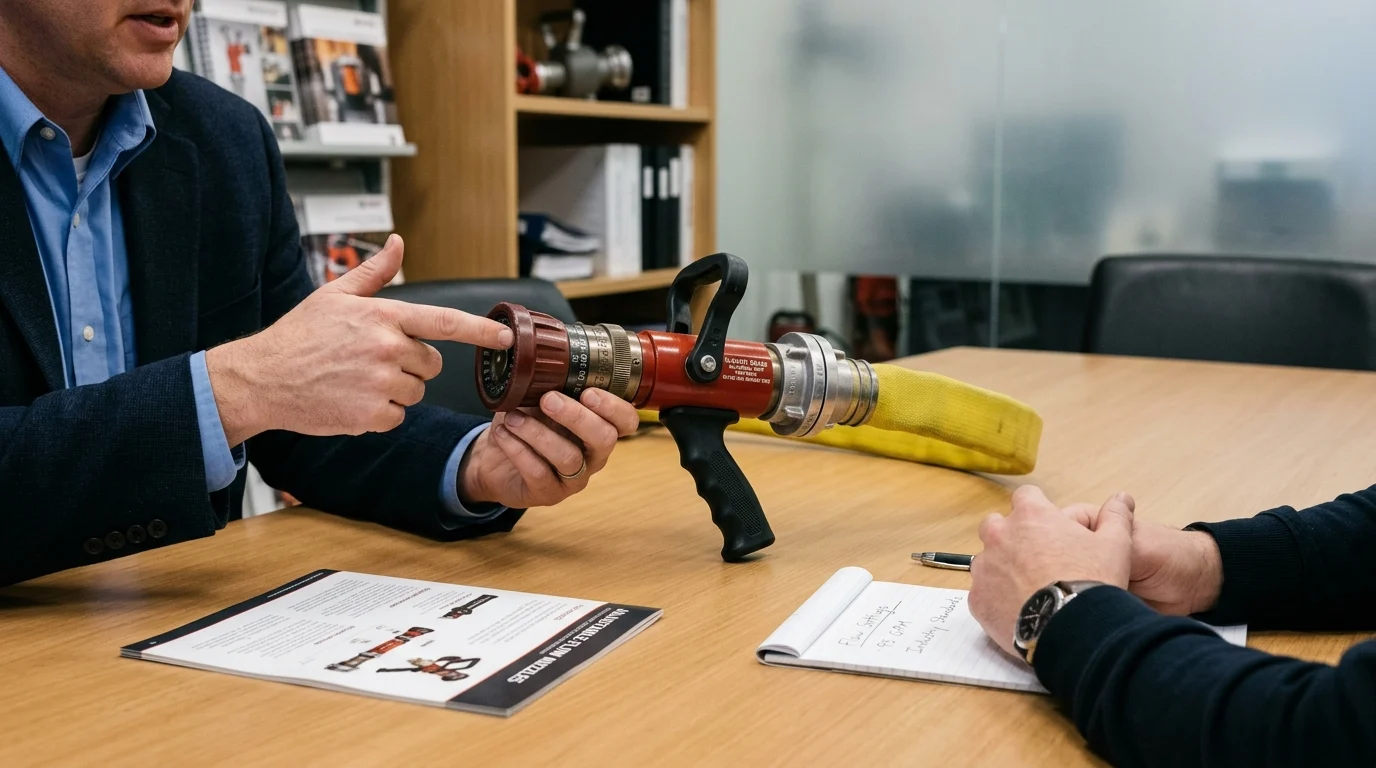
The mechanical architecture of adjustable flow rate fire nozzles dictates their performance reliability under extreme thermal and physical stress. These devices are meticulously engineered to maintain specific discharge pressures—most commonly calibrated to a standard 100 psi. However, modern low-pressure industrial variants operate efficiently at 75 psi or even 50 psi to significantly reduce operator fatigue while maintaining optimal droplet velocity. Understanding the internal geometry and control mechanisms is essential for specifying the correct hardware for specific industrial hazards.
Flow adjustment mechanisms and control options
Precision-machined internal components guarantee accurate water delivery and reliable flow manipulation. The primary mechanism is the selector ring, which rotates to align internal ports or adjust the longitudinal position of a spring-loaded baffle, thereby changing the discharge orifice size. High-quality industrial nozzles feature tactile detents—machined grooves and heavy-duty ball bearings that provide an audible and physical click.
This tactile feedback ensures the operator knows exactly which flow setting is engaged, even when wearing heavy, insulated structural firefighting gloves in zero-visibility environments. However, operators must be trained to ensure the selector ring clicks fully into place; misalignment under high-stress conditions can lead to unpredictable flow rates or inadequate pressure. Per industry standards such as National Fire Protection Association (NFPA) guidelines, these internal mechanisms are typically designed to deliver the selected flow rate within a strict tolerance, often cited as +10% to -0% at the rated pressure. Furthermore, flush settings are universally integrated into the control ring, expanding the orifice to its maximum diameter to clear debris up to 0.25 inches in diameter without requiring the unit to be taken out of service for disassembly.
Stream patterns, pressure, and reach
The rotational nozzle bumper dynamically controls the shape and trajectory of the water discharge. Operators can transition seamlessly from a straight, solid-like stream to a protective wide fog pattern with a simple twist. At a standard 100 psi operating pressure, a 250 GPM straight stream can achieve an effective reach of 120 to 150 feet, which is essential for maintaining safe standoff distances from radiant heat sources or pressurized gas fires. Conversely, the wide fog pattern, which can open to a 120-degree angle, maximizes water surface area for rapid heat absorption and vapor dispersion.
| Stream Pattern | Spray Angle | Primary Industrial Application | Typical Reach (at 100 psi) |
|---|---|---|---|
| Straight Stream | 0° | Deep penetration, long-range attack | 120 – 150 ft |
| Narrow Fog | 15° – 45° | Moderate reach, surface cooling | 50 – 80 ft |
| Wide Fog | 90° – 120° | Radiant heat shielding, vapor mitigation | 15 – 30 ft |
This dynamic control over the stream profile allows a single hose team to perform multiple tactical functions, transitioning from long-range cooling of an exposed storage tank to creating a wide thermal shield if a vapor cloud ignites.
Differences from fixed-flow fire nozzles
Mechanically, selectable gallonage nozzles introduce internal complexity to grant operators direct hydraulic control. A fixed-flow nozzle features an unchangeable orifice designed to deliver a single, specific GPM at a specific pressure. If the pump pressure drops, the flow rate and stream reach of a fixed nozzle degrade in a linear and predictable manner because there is no moving baffle to compensate for or alter the flow dynamics.
In contrast, adjustable flow rate fire nozzles contain moving parts—specifically the metering valve and the selectable gallonage ring—that allow the operator to manually alter the orifice size independent of the pump operator. This mechanical distinction provides deliberate conservation of water or maximization of flow regardless of minor pressure fluctuations originating from the pump panel, distinguishing them from both static fixed-flow models and automatic nozzles that adjust pressure autonomously.
How to Compare Adjustable and Fixed-Flow Nozzles
Selecting the optimal nozzle type requires a rigorous evaluation of facility-specific hazards, hydraulic infrastructure, and responder proficiency. While the previous section highlighted the mechanical differences, industrial fire protection engineers must also weigh practical deployment factors using quantitative performance metrics. It is important to recognize that a typical adjustable nozzle introduces a weight penalty of approximately 1.5 to 3.0 pounds compared to a similarly sized fixed-orifice smooth bore nozzle, which can impact operator endurance over extended deployments.
Performance factors for industrial use
Managing reaction force and ensuring flow consistency are critical when evaluating equipment for heavy-duty applications. Reaction force is the physical pushback exerted on the hose operator, calculated using the standard hydraulic formula: R = 0.0505 × Q × √P (where Q is flow in GPM and P is nozzle pressure in psi). At a flow rate of 200 GPM and a nozzle pressure of 100 psi, the reaction force is approximately 101 pounds, which borders on the maximum manageable limit for a single, well-trained operator.
Adjustable flow rate fire nozzles allow operators to proactively dial down the flow to 125 GPM or 150 GPM if acute fatigue sets in or if personnel shortages occur on the hose line. This adjustment instantly drops the reaction force to a highly manageable 63 to 75 pounds. Fixed-flow nozzles lack this immediate, nozzle-level mitigation capability. Reducing reaction force on a fixed-flow nozzle requires radio coordination with the pump operator to reduce engine discharge pressure, which subsequently compromises stream reach, droplet velocity, and overall suppression quality.
Water efficiency, foam use, and droplet size
Handling Class B flammable liquid fires requires precise control over extinguishing agents and droplet geometry. Adjustable nozzles excel in foam application when paired with inline foam eductors. To produce an effective, stable foam blanket (typically at 1%, 3%, or 6% proportioning rates), the nozzle’s flow setting must precisely match the inline eductor’s rating (e.g., exactly 95 GPM or 125 GPM). Failure to align these settings will result in proportioning failures, rendering the foam blanket ineffective. An adjustable nozzle can be dialed in to match various eductors across a facility, whereas a fixed nozzle is strictly limited to one specific eductor pairing.
Furthermore, the adjustable bumper allows operators to manipulate droplet size for specific thermal challenges. For atmospheric cooling and vapor dispersion, a wide fog produces micro-droplets ranging from 0.3 to 0.5 millimeters in diameter, maximizing the surface to mass ratio for rapid vaporization. For penetrating deep-seated Class A fires or pushing through high thermal columns, the straight stream setting coalesces the water into larger 1.0 to 2.0-millimeter droplets that resist premature evaporation before reaching the fuel base.
Trade-offs between versatility, cost, and complexity
Procurement teams must thoroughly analyze the balance between tactical flexibility and financial investment. Adjustable flow rate fire nozzles typically command a capital cost premium of 20% to 40% over fixed-flow alternatives, depending on the manufacturer and specific features. This premium reflects the complex internal machining, specialized O-rings, and selector mechanisms required for variable flow functionality.
| Evaluation Criteria | Adjustable Flow Rate Nozzles | Fixed-Flow Nozzles |
|---|---|---|
| Tactical Versatility | High (Multiple GPM settings) | Low (Single GPM setting) |
| Capital Cost | Moderate to High ($600 – $1,200+) | Low to Moderate ($300 – $700) |
| Maintenance Needs | Higher (Moving parts, O-ring wear) | Lower (Static internals) |
| Training Burden | Moderate (Requires flow/pressure awareness) | Minimal (Point and shoot) |
Because adjustable models contain internal moving parts, they are inherently more susceptible to particulate jamming if the water source is drafted from open bodies of water, retention ponds, or aging fire mains without adequate inline strainers. Consequently, industrial sites must balance the distinct operational need for flow control against the increased preventative maintenance schedule required to keep complex nozzles fully operational.
How to Specify and Deploy Adjustable Flow Rate Fire Nozzles
Deploying adjustable flow rate fire nozzles across an industrial complex is not a simple plug-and-play operation. It requires meticulous hydraulic calculations to ensure compatibility with existing fire mains, stationary pumps, and the facility’s specific hose complements. Standard industrial fire pumps typically deliver between 1,500 and 3,000 GPM at discharge pressures ranging from 125 to 150 psi. The selected nozzles must not only withstand these operational pressures but also align precisely with the hydraulic limitations of the hose lays utilized by the facility’s emergency response team.
Site hazards, flow requirements, and pump capacity
Perfect synchronization between facility risks and hydraulic infrastructure is necessary to prevent catastrophic failures on the fireground. A common failure point in industrial fire protection design is specifying high-flow adjustable nozzles (e.g., models with 200 or 250 GPM maximum settings) for standard 1.5-inch or 1.75-inch attack lines. Pushing 250 GPM through a 100-foot section of 1.75-inch hose generates a friction loss approaching 95 psi, which can easily overtax portable pumps, burst aging hose jackets, or result in dangerously inadequate nozzle pressure.
Industrial sites must conduct rigorous hydraulic audits to ensure that the maximum selectable flow rate on the nozzle can be adequately supported by the pump’s discharge curve and the hose diameter. For petrochemical facilities dealing with high-hazard Class B fires, NFPA 11 guidelines dictate specific application densities (e.g., 0.16 GPM per square foot for standard hydrocarbon spills). The ability to precisely calibrate the flow of adjustable nozzles makes them highly effective for meeting these strict density compliance parameters without depleting foam concentrate reserves prematurely.
Commissioning, inspection, and maintenance steps
Strict regulatory frameworks govern the lifecycle management of suppression equipment to ensure life safety. Under NFPA 1962, fire nozzles must undergo rigorous annual inspection and testing. Commissioning protocols typically require physical flow testing at the nozzle’s rated pressure (such as 100 psi or 75 psi) utilizing a calibrated pitot gauge and inline flow meter. This testing verifies that actual discharge volumes fall within permissible variances across all selector settings.
Additionally, while fire hoses require high-pressure hydrostatic testing, nozzles must be subjected to operational checks and valve leakage testing at their designated working pressure to ensure structural integrity and the absence of leaks around the selector ring, shutoff valve, and bumper seals. Routine maintenance involves flushing the nozzle thoroughly after every use, inspecting the spinning bumper teeth for impact damage, and lubricating the ball valve assembly with manufacturer-approved, non-petroleum-based lubricants to prevent O-ring degradation and ensure smooth actuation.
Compliance and procurement considerations
Selecting the right hardware extends well beyond basic functionality and upfront costs. Procurement teams must mandate that all supplied nozzles carry appropriate third-party certifications, most notably FM Approval and Underwriters Laboratories (UL) Listing. These independent certifications validate that the equipment has survived extreme environmental testing, including prolonged high-temperature exposure, rigorous salt-spray corrosion tests, and standardized rough handling drop tests from heights of up to 6 feet.
For marine terminals, offshore platforms, or highly corrosive chemical processing environments, compliance may also dictate the use of specific metallurgical alloys. In these scenarios, procurement documents must explicitly forbid standard extruded aluminum components in favor of hard-anodized alloys, bronze, or stainless steel variants to ensure the nozzle survives the ambient atmospheric conditions over its projected lifecycle.
How to Build a Final Selection Framework
Finalizing the procurement of adjustable flow rate fire nozzles demands a structured selection framework that evaluates both immediate tactical benefits and the long-term total cost of ownership. Industrial fire protection assets are expected to maintain peak mission readiness for lifespans typically ranging from 10 to 15 years in harsh conditions. Establishing a standardized evaluation matrix ensures that the chosen equipment aligns seamlessly with the facility’s specific hazard profile, maintenance capabilities, and capital expenditure constraints.
Decision criteria for mission-critical performance
Material science, hydraulic compatibility, and ergonomic design form the foundation of a reliable equipment roster. The metallurgical composition of the nozzle is paramount. For standard indoor manufacturing environments, hard-coat anodized aluminum offers an optimal strength-to-weight ratio. However, for offshore platforms or chemical processing plants exposed to caustic atmospheres, decision-makers should specify specialized marine brass, super-duplex stainless steel, or 6Mo alloys rather than standard 316-grade stainless steel. While these advanced alloys increase the unit weight, materials like super-duplex offer a Pitting Resistance Equivalent Number (PREN) exceeding 40, making the nozzle highly resistant to chloride-induced stress corrosion cracking.
Ergonomic criteria must also be rigorously evaluated. This includes measuring the physical actuation force required to rotate the flow selector ring and open the bail shutoff valve while the nozzle is fully pressurized at 100 psi. Manufacturer guidelines often recommend keeping rotational force below 15 pounds, as designs requiring excessive effort can severely hinder operator performance and delay critical flow adjustments in high-stress scenarios.
Checklist for industrial purchasing teams
Establishing a standardized evaluation matrix serves as the final gateway before capital expenditure is authorized. First, verify the exact compatibility of the nozzle base threads (e.g., National Standard Thread vs. National Pipe Straight Hose, or specific regional couplings like Storz or BS336) to completely eliminate the need for flow-restricting adapters on the fireground. Second, confirm the Minimum Order Quantity (MOQ) and manufacturing lead times, as specialized industrial-grade nozzles may require 8 to 12 weeks for fabrication and delivery.
Third, evaluate the manufacturer’s warranty and service level agreement; premium industrial nozzles should carry a minimum 5-year warranty covering manufacturing defects, premature seal failures, and internal valve degradation. Finally, require the vendor to provide comprehensive hydraulic flow charts and localized, hands-on training support. This ensures that the facility’s response personnel can fully leverage the variable flow capabilities without compromising hydraulic safety or exceeding the limitations of the site’s fire pump infrastructure.
Key Takeaways
- Select adjustable flow rate fire nozzles when industrial hazards require operators to change water delivery without stopping the hose line.
- Use lower GPM settings for boundary cooling, overhaul, and hotspot control to reduce water damage and contaminated runoff.
- Increase flow to higher industrial settings, such as 250 GPM or more where appropriate, for heavy fire attack, vapor mitigation, or foam application.
- Match nozzle flow range to the facility’s hazards, hose size, pump capacity, and applicable fire protection standards before procurement.
- For global industrial projects, prioritize certified suppliers with reliable quality systems and compatible fire protection equipment.
Frequently Asked Questions
What is an adjustable flow rate fire nozzle?
It is a selectable-gallonage hose nozzle that lets operators manually choose different flow settings, such as lower GPM for cooling or higher GPM for aggressive attack, without shutting down the hose line.
How do adjustable flow nozzles differ from automatic nozzles?
Adjustable flow nozzles let the operator select the flow rate manually, while automatic nozzles adjust internally to maintain pressure. Selectable models give industrial teams direct control over water volume.
Why are adjustable flow nozzles useful in industrial facilities?
Industrial fires can change quickly due to chemicals, fuels, machinery, or storage hazards. Adjustable nozzles help crews increase or reduce flow in real time to match fire intensity and protect assets.
Can adjustable flow nozzles help reduce water damage?
Yes. By lowering GPM during containment and overhaul, operators can limit unnecessary discharge, helping reduce damage to machinery, electrical equipment, inventory, and building interiors.
What flow ranges are common for industrial adjustable nozzles?
Standard handline models may range from about 30 to 125 GPM, while larger industrial nozzles often cover 95 to 250 GPM. Master stream variants can reach 350 GPM or more.

Post time: Jun-17-2026