

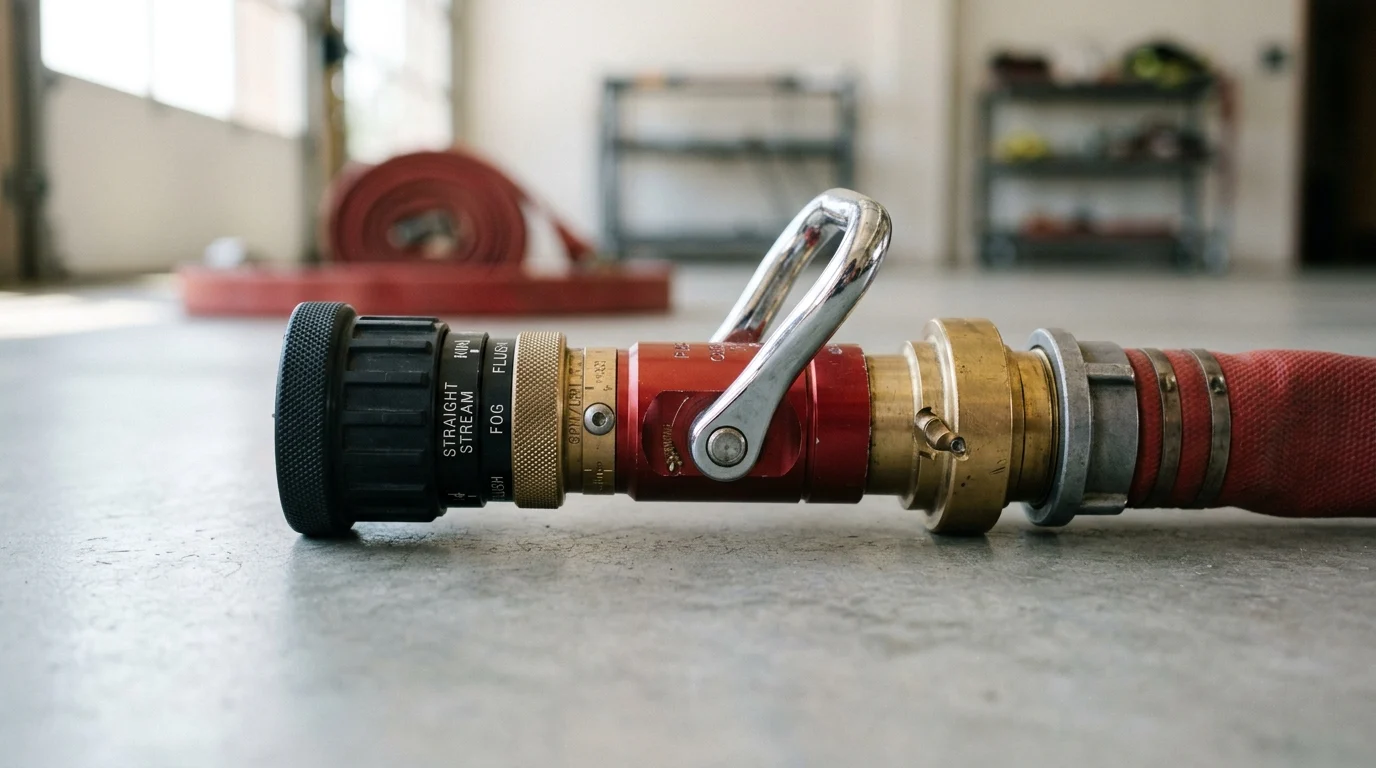
Why a Weak Fire Water Nozzle Stream Matters
A fire water nozzle serves as the critical delivery point in any fire suppression system, converting hydraulic pressure into stream velocity and shape. When a nozzle stream is weak, the entire suppression strategy is compromised. A weak stream lacks the force and kinetic energy required to penetrate the rising heat of a fire (thermal columns), significantly reducing the cooling capacity and reach of the water application. Fixing the issue starts with understanding where the water loses its power.
In industrial fire protection and municipal firefighting, stream effectiveness is not a subjective observation; it is a measurable parameter defined by flow rate, discharge pressure, and reach. A drop in nozzle performance directly correlates to a reduction in gallons per minute (GPM) or liters per minute (LPM) delivered to the seat of the fire. Identifying why a stream is underperforming requires a systematic analysis of the water’s path, from the water supply through the pumping apparatus to the discharge orifice.
Acceptable Stream Performance
Acceptable stream performance is governed by strict hydraulic parameters and industry standards, such as NFPA 1962 and NFPA 14. A functional fire water nozzle must deliver its rated flow at its designed operating pressure. For standard smooth bore nozzles, the accepted baseline pressure is typically 50 psi (3.5 bar) for handlines and commonly 80 psi (5.5 bar) for master streams, though these can vary by manufacturer and jurisdiction. In contrast, traditional combination or fog nozzles require a higher operating pressure, generally ranging from 75 to 100 psi (5.2 to 6.9 bar), to properly atomize water and maintain stream velocity.
When pressure falls below these established thresholds, the stream loses its cohesive shape and penetrating power. A reduction of just 15% below the rated operating pressure can result in a disproportionate loss of reach and droplet velocity. Acceptable performance dictates that the stream must remain unbroken for a specified distance to ensure personnel can operate from a safe standoff radius without sacrificing suppression efficacy.
Operational and Safety Risks
The operational risks of a weak fire water nozzle stream extend far beyond mere inconvenience. A degraded stream forces personnel to move closer to the fire environment, exposing them to radiant heat that can easily exceed critical safety thresholds. Furthermore, inadequate flow rates fail to absorb the heat energy (British Thermal Units or BTUs) generated by modern fuel loads, allowing the fire to outpace the suppression effort and potentially leading to rapid fire progression or flashover conditions.
Safety is also compromised by the loss of stream maneuverability. Combination nozzles operating at sub-optimal pressures fail to produce an effective protective fog pattern, which is heavily relied upon for hydraulic ventilation and thermal shielding. In industrial settings, a weak master stream may fail to cool adjacent exposures, increasing the probability of cascading structural failures or catastrophic boiling liquid expanding vapor explosions (BLEVEs) in pressurized storage tanks.
Inspection and Compliance Impacts
From a regulatory standpoint, weak nozzle performance triggers immediate compliance failures during annual testing and commissioning. NFPA 25 and NFPA 1962 mandate rigorous flow testing protocols for standpipe systems, fire pumps, and suppression hardware. If a nozzle fails to flow within 10% of its rated capacity at the specified discharge pressure, the equipment or the supporting system must be flagged for repair or replacement.
Insurance underwriters and authorities having jurisdiction (AHJs) closely scrutinize flow test data. A documented history of weak stream performance can lead to the red-tagging of a facility’s fire protection system, resulting in elevated insurance premiums or the revocation of occupancy permits. Maintaining meticulous records of baseline flow data and routine pitot gauge readings is essential for demonstrating continuous compliance. While field operators can perform immediate emergency troubleshooting, official compliance testing and permanent system repairs must always be performed by certified fire protection technicians.
Common Causes of Weak Nozzle Flow

Diagnosing a weak fire water nozzle stream requires isolating the variables within the hydraulic system. The nozzle itself is merely the endpoint; its performance is entirely dependent on the upstream conditions. Deficiencies typically fall into three primary categories: supply-side mechanical failures, internal flow restrictions, and distribution network losses.
Systematic troubleshooting dictates evaluating the largest potential points of failure first. By applying the foundational fire ground hydraulic formula—Pump Discharge Pressure (PDP) equals Nozzle Pressure (NP) plus Friction Loss (FL) plus or minus Elevation Pressure (EP)—operators can mathematically pinpoint where the loss of energy is occurring. A deviation between calculated expectations and actual field performance isolates the root cause.
Low Supply Pressure or Pump Performance
The most common culprit behind a weak stream is inadequate supply pressure or degraded pump performance. If a municipal hydrant or static water source cannot deliver the required volume, the pump will experience cavitation. Cavitation occurs when the absolute pressure of the fluid falls below its vapor pressure, creating micro-bubbles that implode against the pump impeller. This not only destroys the pump’s mechanical integrity but severely truncates the discharge pressure, capping the nozzle’s output regardless of engine RPM.
Even with an adequate water supply, internal pump wear can restrict performance. Clearance rings within a centrifugal pump wear down over time, allowing water to bypass the impeller and reducing overall efficiency. If a pump is rated for 1500 GPM at 150 psi but can only achieve 1000 GPM at that pressure during an annual draft test, the resulting supply deficiency will manifest as a persistently weak nozzle stream. Addressing internal pump wear or cavitation damage requires professional mechanical repair and cannot be resolved through field adjustments.
Blockage, Corrosion, or Worn Components
Flow restrictions caused by blockages, corrosion, or worn internal components act as severe choke points in the hydraulic system. In industrial and marine environments, tuberculation—the buildup of rust and mineral deposits inside iron standpipes—can reduce the internal diameter of a pipe by 15% to 20%. Because friction loss increases exponentially with the reduction of pipe diameter, this corrosion drastically reduces the residual pressure available at the nozzle inlet.
Within the fire water nozzle itself, debris such as rocks, rust flakes, or degraded gasket material can become lodged in the waterway or the baffle mechanism. Automatic nozzles are particularly susceptible to this issue. The internal spring mechanism that modulates the baffle to maintain a constant discharge pressure can become jammed by particulate matter or calcification, locking the nozzle in a high-flow or low-flow position and destroying stream quality.
Hose, Valve, and Elevation Issues
Hose configurations, valve settings, and elevation changes introduce significant friction loss that must be overcome by the pump. Elevation loss follows a standard physical constant: every foot of elevation gain results in a pressure loss of approximately 0.434 psi (varying slightly with water temperature and density). Therefore, operating a nozzle on the 10th floor of a building inherently deducts over 43 psi from the system before friction loss is even calculated.
Note: The friction loss figures below are standard approximations. Actual coefficients vary significantly based on specific hose construction, brand, age, lining condition, and coupling type.
| Hose Diameter (Inches) | Flow Rate (GPM) | Friction Loss per 100 ft (psi) | Typical Application |
|---|---|---|---|
| 1.50 | 100 | ~30.0 | Light interior attack |
| 1.75 | 150 | ~34.0 | Standard interior attack |
| 2.50 | 250 | ~12.5 | Heavy fire / Exposures |
| 3.00 | 400 | ~12.8 | Supply / Master stream |
Furthermore, partially closed valves or improperly calibrated Pressure Reducing Valves (PRVs) in standpipe systems can throttle the flow unexpectedly. Adjusting PRVs must be handled professionally, as improper calibration can cause catastrophic system failure. Kinks in the hose line also create localized turbulence and friction. A single severe kink in a 1.75-inch attack line can restrict flow by up to 30%, instantly degrading the reach and penetration of the fire water nozzle stream.
How to Diagnose Low Nozzle Pressure
Accurate diagnosis of low nozzle pressure relies on empirical data rather than visual estimation. Fire protection engineers and pump operators must utilize calibrated instrumentation to measure static and residual pressures across the system. Without precise measurement, correcting a weak stream becomes a process of trial and error, which is unacceptable during a live fire event or a compliance audit.
The diagnostic process involves moving systematically from the water source to the discharge orifice. By capturing data at discrete intervals—at the hydrant, at the pump discharge manifold, at the standpipe outlet, and finally at the nozzle—technicians can map the pressure drops and identify the exact component responsible for the weakness.
Key Field Measurements
The most critical field measurement for assessing stream strength is the pitot gauge reading. A pitot tube measures the velocity pressure of the water exiting the nozzle. By inserting the pitot blade into the center of a smooth bore stream at a distance equal to half the orifice diameter, operators obtain a precise pressure reading. This reading is then applied to the standard flow formula: Flow (GPM) = 29.83 × c × d² × √p, where ‘c’ is the coefficient of discharge, ‘d’ is the orifice diameter, and ‘p’ is the pitot pressure.
For combination and fog nozzles, where pitot tubes cannot be effectively used due to the broken stream pattern, inline flow meters are required. These devices are installed directly behind the nozzle or at the pump discharge to provide real-time GPM data. Comparing the inline flow meter reading against the manufacturer’s rated flow for a given pump discharge pressure immediately highlights any discrepancies in stream performance.
Supply-Side vs Nozzle-Side Testing
Differentiating between supply-side and nozzle-side issues is the core of hydraulic diagnostics. Supply-side testing involves monitoring the master intake gauge on the fire pump. If the static pressure drops by more than 20% when the line is charged and flowing (residual pressure), the water supply is inadequate for the demanded flow, and the weak stream is a source issue. The pump cannot push water it does not have.
Conversely, nozzle-side testing focuses on the pressure lost between the pump and the nozzle. If the pump operator is maintaining a discharge pressure of 150 psi, but an inline gauge at the nozzle inlet reads only 30 psi, the loss is excessive. This indicates an obstruction, a severely kinked hose, a closed intermediate valve, or an incorrect hose diameter for the target flow rate. If the inlet pressure is adequate (e.g., 100 psi) but the stream is still weak, the nozzle itself is internally defective.
Safety Controls During Testing
Conducting flow tests and pressure diagnostics introduces significant force into the environment, necessitating strict safety controls. High-pressure water streams exert massive reaction forces. A 1.5-inch smooth bore nozzle flowing 300 GPM at 50 psi generates approximately 106 pounds of nozzle reaction force, requiring multiple personnel or mechanical anchoring to control safely during testing.
Additionally, operators must mitigate the risk of water hammer—a destructive pressure surge caused by the rapid deceleration of water. Closing a nozzle bale or a testing valve too quickly can generate pressure spikes exceeding 200 psi to 300 psi, which can rupture hoses, damage pump impellers, and destroy internal nozzle baffles. Valves must be operated slowly, and pressure relief valves (PRVs) on the pump must be properly set to bypass excess pressure during diagnostic procedures.
Nozzle Specifications That Affect Stream Strength
The inherent design and engineering specifications of a fire water nozzle dictate its baseline hydraulic requirements. Not all nozzles are created equal; their internal geometry, flow ratings, and operational mechanisms determine how they utilize available water pressure. Selecting an incompatible nozzle for a specific hydraulic system is a primary reason for chronically weak streams.
Understanding the technical specifications of different nozzle types allows fire protection professionals to match the hardware to the available water supply and hose layout. Upgrading to a high-performance nozzle will not resolve a weak stream if the underlying pump and hose infrastructure cannot meet the nozzle’s strict operational thresholds.
Fixed, Fog, and Smooth-Bore Nozzles
Smooth-bore nozzles represent the simplest and most hydraulically efficient design. Consisting of a tapered pipe ending in a cylindrical orifice, they provide maximum reach and penetration at lower operating pressures. Because they have no internal baffles, they are highly resistant to debris blockages and produce a solid column of water with minimal air entrainment.
Fixed-gallonage and selectable-gallonage fog nozzles utilize a central baffle to deflect water into a specific pattern, requiring higher pressures to achieve the desired droplet size (optimally between 0.3 and 1.0 mm for heat absorption). Automatic nozzles take this a step further by incorporating a dynamic spring-loaded baffle that continuously adjusts the orifice size to maintain a constant tip pressure, regardless of flow fluctuations. While automatic nozzles optimize stream reach under varying conditions, they mask supply deficiencies; if the flow drops severely, the stream may look visually adequate but will lack the GPM needed for actual fire suppression.
Rated Flow and Pressure Requirements
Every fire water nozzle is engineered for a specific rated flow at a specific rated pressure. Mismatching these requirements with field conditions guarantees poor performance. For example, deploying a 250 GPM fixed-gallonage nozzle on a 1.75-inch hose line is hydraulically flawed; the extreme friction loss in the small-diameter hose will make it nearly impossible for a standard apparatus pump to deliver the necessary tip pressure, resulting in a weak, drooping stream.
| Nozzle Type | Typical Operating Pressure | Flow Range (GPM) | Debris Tolerance | Maintenance Need |
|---|---|---|---|---|
| Smooth Bore | 50 psi (3.5 bar) | 150 – 300+ | High | Low |
| Fixed Fog | 75 – 100 psi (5.2 – 6.9 bar) | 60 – 250 | Moderate | Moderate |
| Selectable Fog | 75 – 100 psi (5.2 – 6.9 bar) | 30 – 200 | Moderate | Moderate |
| Automatic Fog | 75 – 100 psi (5.2 – 6.9 bar) | 70 – 200 | Low | High |
Facilities and fire departments must standardize their nozzle specifications to match their pump capacities and hose inventories. If an industrial complex operates a fire pump limited to 100 psi total discharge pressure, utilizing 100 psi automatic nozzles at the end of long hose lays is mathematically destined to fail. In such scenarios, transitioning to low-pressure fog nozzles (rated at 50 or 75 psi) or smooth-bore nozzles is the only way to ensure a strong, capable stream.
When to Repair or Replace a Nozzle
Determining when to repair or replace a nozzle hinges on quantitative performance metrics and physical wear limits. According to NFPA 1962, any nozzle that fails to flow within 10% of its rated capacity at its designated pressure, or fails to operate smoothly across all pattern selections, must be removed from service. Visual indicators of failure include spinning teeth that are missing or seized, a bale (shutoff handle) that leaks under pressure, or a deformed bumper.
Internal components degrade over time due to high-velocity water flow and particulate abrasion. The shutoff ball valve can become scored, leading to dangerous leaks when closed, while the spring in an automatic nozzle can suffer from metal fatigue, causing it to open prematurely at lower pressures. If a rebuild kit—which typically includes new O-rings, a seat, and a shutoff ball—cannot restore the nozzle to its factory flow specifications, complete replacement of the unit is mandatory.
How to Restore and Prevent Weak Nozzle Streams
Restoring a weak fire water nozzle stream requires rapid, methodical intervention on the fireground or during system maintenance. Once the root cause is identified, operators must execute corrective actions that immediately stabilize the flow. Beyond emergency field fixes, preventing future stream degradation relies on a rigorous lifecycle management protocol. Fire suppression equipment sits idle in harsh environments for extended periods, making it highly susceptible to environmental degradation. Shifting from reactive troubleshooting to proactive maintenance ensures that nozzles and their supporting infrastructure perform to specification when deployed.
Immediate Corrective Actions
When a weak stream is identified during active operation, front-load your troubleshooting with practical emergency field actions. First, the hose line crew must walk the line to physically remove any severe kinks, uncoil stacked hose, and clear objects resting on the line. Next, verify that all intermediate valves are fully open. Simultaneously, the pump operator should be instructed to increase the Pump Discharge Pressure (PDP) in calculated increments—typically 10 psi to 20 psi—while monitoring the master flow meter to see if the GPM increases.
If the stream remains weak despite adequate pump pressure and a clear hose lay, the nozzle is likely fouled with debris. Operators can perform a rapid field flush by opening the nozzle to its widest fog setting (or utilizing the dedicated ‘flush’ setting on modern combination nozzles) to allow trapped particulate matter to pass through the expanded orifice. If clearing the nozzle fails, the shutoff bale must be closed completely, and a secondary line must be deployed immediately to maintain suppression while the defective unit is swapped out.
Preventive Maintenance Schedule
A robust preventive maintenance schedule is the definitive safeguard against hardware-induced weak streams. Routine protocols must include monthly visual inspections to verify that the nozzle waterway is clear, the gasket is intact, and the shutoff mechanism operates without binding. Moving parts, such as the pattern control sleeve and the shutoff ball, should be cleaned and lubricated using only the manufacturer-specified silicone-based grease; petroleum-based lubricants will degrade the internal rubber O-rings.
Annually, every nozzle must undergo a standardized flow test using an inline flow meter and a pitot gauge to confirm it meets its rated GPM and pressure specifications. On a macro level, the supporting infrastructure must also be maintained. Standpipe systems require a 5-year hydrostatic test and internal inspection to identify tuberculation or PRV failures that could throttle water delivery before it ever reaches the nozzle.
Choosing the Fastest Compliant Fix
When an inspection reveals a compromised nozzle, choosing the fastest compliant fix depends on the
Key Takeaways
- Check the full water path first, including the supply, pump, valves, hose, couplings, strainers, and nozzle tip, because pressure loss can occur before water reaches the nozzle.
- Verify that the nozzle is operating at its rated pressure, such as about 50 psi for many smooth bore handlines and 75 to 100 psi for many fog nozzles.
- Remove kinks, reduce unnecessary hose length, and account for friction loss to restore flow and stream reach during high-demand firefighting operations.
- Inspect and flush the nozzle if the stream is distorted, because rust, sediment, damaged gaskets, or debris can restrict the discharge opening.
- Replace or service any nozzle with damaged threads, corrosion, deformed tips, or unreliable pattern control before returning it to emergency use.
- Use certified fire protection equipment and documented inspection routines to support safety, compliance, and dependable suppression performance.
Frequently Asked Questions
What is the most common reason a fire water nozzle stream becomes weak?
The most common causes are low supply pressure, hose kinks, clogged strainers, partially closed valves, or debris inside the nozzle. Start by checking the water path from source to nozzle before assuming the nozzle itself has failed.
What pressure should a fire water nozzle normally operate at?
Many smooth bore handline nozzles operate around 50 psi, while master streams may use about 80 psi. Traditional fog or combination nozzles often need 75 to 100 psi to produce proper reach and atomization.
Can a clogged nozzle reduce firefighting performance?
Yes. Sediment, rust, gasket fragments, or foreign material can restrict flow and distort the stream pattern. Shut down safely, inspect the tip and internal passages, flush the nozzle, and replace damaged parts before returning it to service.
How do hose size and length affect nozzle stream strength?
Longer hoses, undersized hoses, sharp bends, and high-flow operations increase friction loss. If pump pressure is not adjusted to compensate, less pressure reaches the nozzle, causing reduced flow, poor reach, and unstable stream patterns.
When should a weak fire water nozzle be replaced?
Replace it when cleaning, gasket replacement, and pressure correction do not restore rated performance, or when there is visible corrosion, damaged threads, a deformed tip, or unreliable pattern adjustment.

Post time: Jun-24-2026