

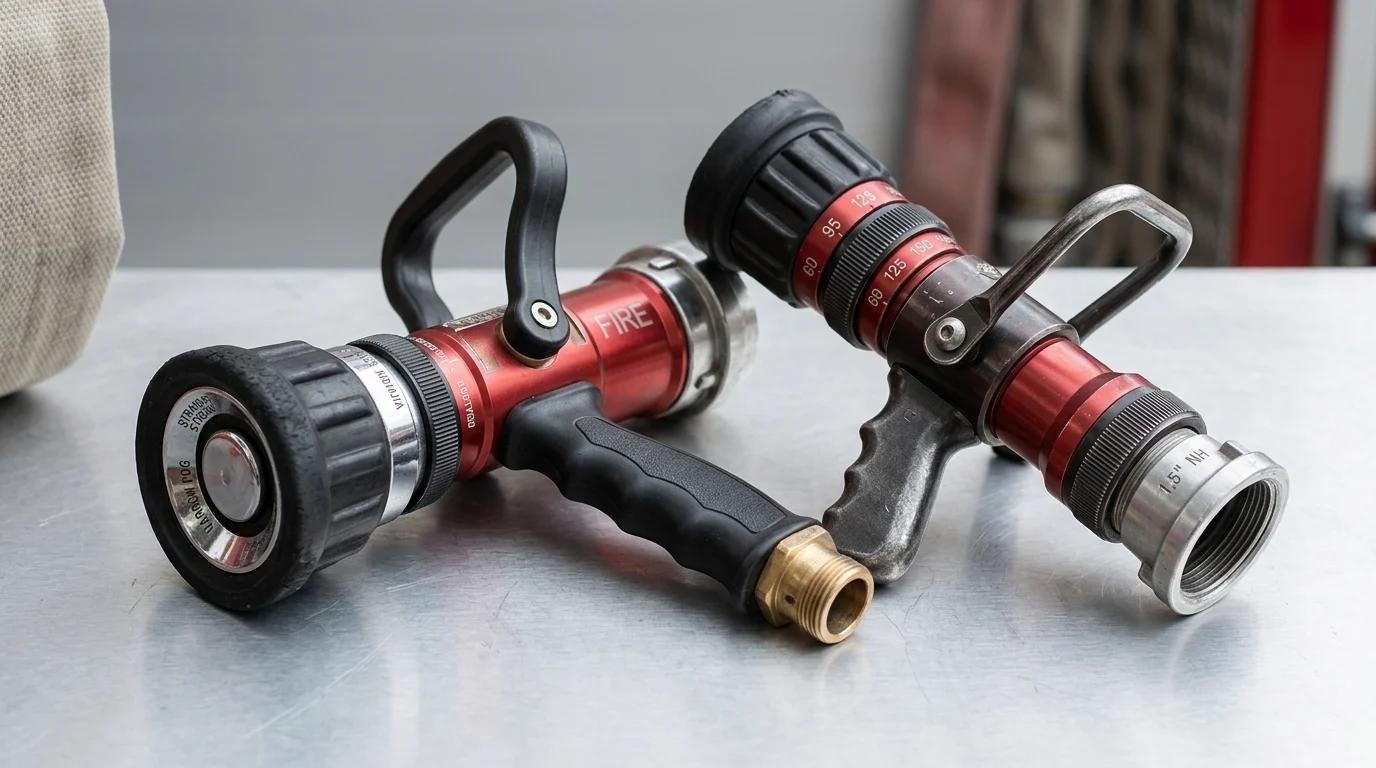
Introduction
Selecting a marine fire nozzle is not just about spray pattern or flow rate; certification determines where the equipment can be used, how it is tested, and whether a vessel meets regulatory requirements. MED and UL marks both signal verified performance, but they come from different approval systems and serve different compliance frameworks in marine firefighting. Understanding that distinction helps shipowners, yard engineers, and procurement teams avoid specification mistakes, inspection issues, and costly retrofits. This article explains what each certification means, how their testing and acceptance differ, and when one may be required over the other in practical marine applications.
MED vs UL Listed Marine Fire Nozzles: Why the Difference
Marine fire suppression systems rely heavily on the terminal performance of fire nozzles to protect crew, cargo, and the vessel itself. Because the maritime environment presents unique challenges—ranging from highly corrosive saltwater exposure to isolated firefighting scenarios where no external municipal help is available—the equipment must perform flawlessly under extreme conditions. Consequently, international and regional regulatory bodies mandate strict certification frameworks to guarantee reliability. The two most prominent certifications in the global maritime industry are the Marine Equipment Directive (MED) and Underwriters Laboratories (UL) listing.
While both certifications aim to ensure high-quality fire suppression capabilities, they originate from different regulatory philosophies and govern different jurisdictions. Choosing between an MED-certified nozzle and a UL-listed nozzle is not merely a matter of preference; it is a critical engineering and compliance decision. Misunderstanding the jurisdictional boundaries, testing parameters, and documentation requirements of these marks can lead to catastrophic operational failures, severe regulatory penalties, and significant financial losses during vessel commissioning or subsequent port state inspections.
Impact on statutory compliance and vessel delivery
Statutory compliance forms the legal backbone of any commercial vessel’s ability to operate, trade, and secure insurance. Fire safety equipment, particularly fire mains and their corresponding nozzles, falls under the strict purview of the International Convention for the Safety of Life at Sea (SOLAS) Chapter II-2. When a vessel is flagged to a European Union member state, or operates heavily within jurisdictions enforcing European maritime standards, MED certification is an absolute statutory requirement. Failure to provide MED-certified nozzles on an EU-flagged vessel guarantees immediate non-compliance.
The impact of this non-compliance directly affects vessel delivery schedules. Classification societies, acting on behalf of flag states, conduct rigorous surveys prior to issuing a Passenger Ship Safety Certificate or Cargo Ship Safety Equipment Certificate. If surveyors identify unapproved or improperly certified fire nozzles, they will issue a deficiency or a condition of class. Remedying this error can delay a vessel’s delivery by 30 to 90 days, depending on the availability of replacement stock, the logistical challenges of delivering compliant nozzles to the shipyard, and the surveyor’s availability for reinspection.
Why shipyards, owners, and buyers need to know
For shipyards, owners, and procurement managers, understanding the distinction between MED and UL listings is a matter of profound financial and operational risk management. Shipyards operate on tight margins and strict delivery timelines. Installing the wrong type of fire nozzle across a large commercial vessel—which typically requires 40 to 60 individual nozzles for a standard Aframax tanker or Panamax bulk carrier—can incur direct replacement costs ranging from $15,000 to $25,000. This figure strictly covers the hardware and ignores the associated labor overhead.
However, the hardware cost is negligible compared to the secondary financial impacts. If a vessel is detained by Port State Control (PSC) due to non-compliant fire suppression equipment, the resulting operational paralysis is devastating. Drydock or port delay penalties frequently exceed $10,000 per day for commercial freighters and can surpass $50,000 per day for specialized offshore vessels or cruise ships. Buyers must therefore specify the exact certification required during the initial procurement phase, ensuring that the selected nozzles align perfectly with the vessel’s flag state, classification society rules, and intended operational theater.
What MED and UL Listed Marine Fire Nozzles Mean
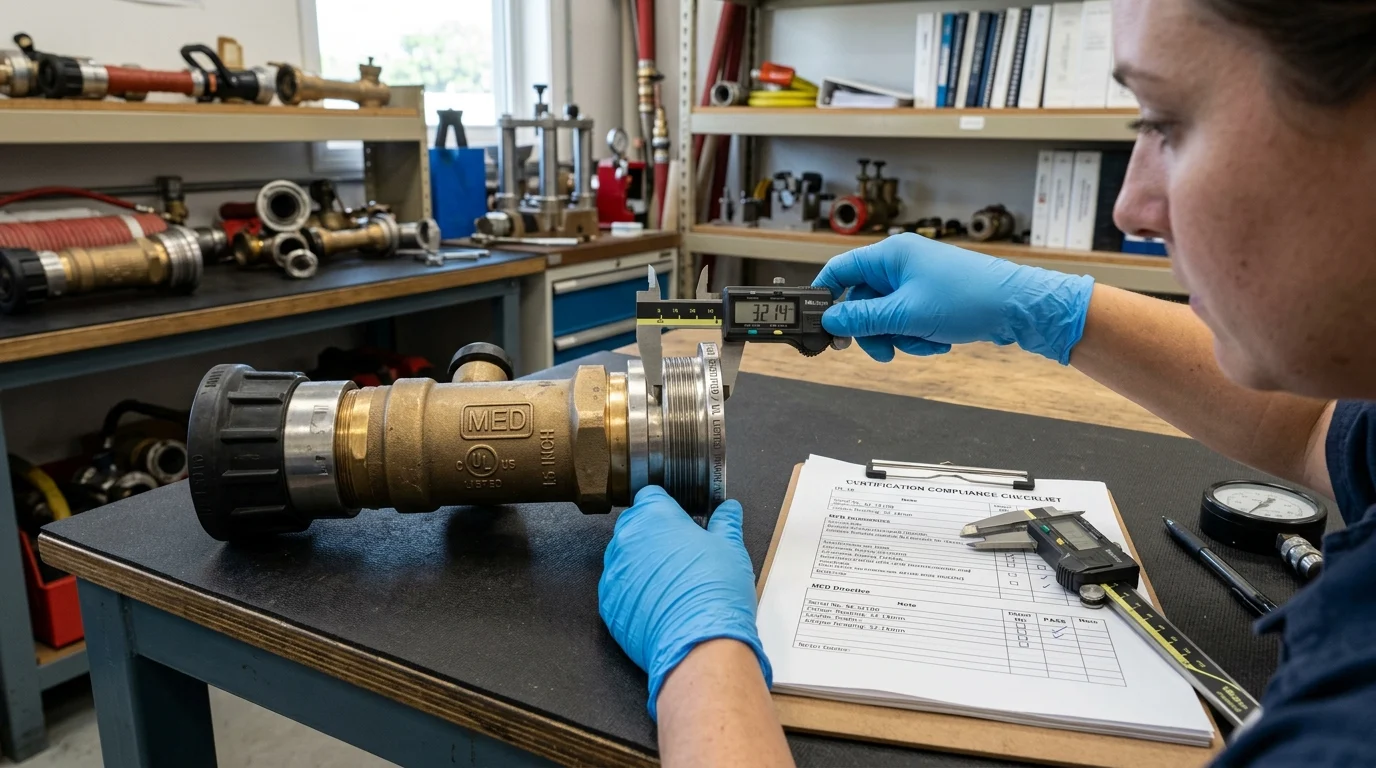
Navigating the complex landscape of marine fire protection requires a clear understanding of what MED and UL certifications actually represent. These marks are not interchangeable, nor do they signify the exact same testing criteria. Instead, they serve as proof that a product has successfully passed a specific battery of tests mandated by distinct regulatory authorities. Understanding the structural and procedural differences between these two pathways is essential for marine engineers and procurement specialists.
At their core, MED and UL listings dictate the manufacturing tolerances, material grades, hydraulic performance, and quality assurance processes that a manufacturer must adhere to. While MED is deeply intertwined with international maritime treaties, UL represents an independent, globally recognized safety science framework heavily utilized in North American jurisdictions and specialized commercial sectors.
How MED certification applies to fire nozzles
The Marine Equipment Directive (Directive 2014/90/EU) is a regulatory framework established by the European Union to ensure that equipment installed on EU-flagged ships complies with international standards. Often referred to as the “Wheelmark” due to its distinctive logo, MED certification signifies that a fire nozzle meets the rigorous requirements set forth by the International Maritime Organization (IMO), a specialized United Nations agency responsible for maritime safety. For fire nozzles, this typically involves testing against harmonized standards such as EN 15182-1 and EN 15182-2.
The MED certification process is heavily structured around two primary phases: Module B and Module D. Module B is the EC Type Examination, where a Notified Body rigorously tests a prototype nozzle to ensure it meets all performance and environmental criteria. If successful, a certificate valid for up to 5 years is issued. However, Module B alone is insufficient for market entry. The manufacturer must also maintain Module D, which is a comprehensive audit of their production quality assurance system. This ensures that every subsequent nozzle rolling off the assembly line matches the exact specifications of the approved prototype.
How UL listing applies to marine fire nozzles
Underwriters Laboratories (UL) takes a different approach. A UL listing for a marine fire nozzle indicates that the product has been tested to UL’s proprietary standards, such as UL 401 (Portable Water Spray Extinguishing System Units) or UL 162 (Foam Equipment and Liquid Concentrates), with specific marine supplements. UL-listed marine equipment is the gold standard for vessels operating under the jurisdiction of the United States Coast Guard (USCG) and is frequently mandated for offshore oil and gas platforms governed by North American regulations.
Unlike the MED’s 5-year certificate renewal cycle, a UL listing requires an ongoing, highly aggressive follow-up service program. Manufacturers producing UL-listed marine fire nozzles are subjected to unannounced factory inspections up to 4 times a year. During these visits, UL inspectors pull products directly from the production line to verify continuous compliance with the original testing parameters. This relentless oversight ensures exceptionally high manufacturing consistency.
| Feature | MED Certification (Wheelmark) | UL Marine Listing |
|---|---|---|
| Primary Jurisdiction | European Union / Global SOLAS | North America / USCG |
| Core Standard Framework | EN 15182 / IMO Resolutions | UL 401 / UL 162 Supplements |
| Quality Audit Frequency | Annual (Module D) | Quarterly (Unannounced) |
| Certificate Validity | Up to 5 Years | Continuous (conditional on audits) |
Key Differences Between MED and UL Listed Marine Fire Nozzles
While both MED and UL-listed nozzles are designed to extinguish fires efficiently, the technical specifications and physical testing protocols they endure differ significantly. These differences stem from the distinct environmental assumptions and historical firefighting doctrines embedded within European and North American regulatory bodies. Consequently, an MED nozzle and a UL nozzle may behave differently in the hands of a marine firefighter.
Engineers must scrutinize these differences closely, as they affect everything from the hydraulic design of the vessel’s fire main to the lifecycle maintenance of the equipment. The key variances fall into three primary categories: physical performance metrics, documentation and traceability, and the strict application limits imposed by international maritime law.
Performance, materials, pressure ratings, and spray patterns
Material resilience and hydraulic performance are evaluated distinctly by MED and UL standards. Because MED is exclusively a maritime directive, its environmental testing is exceptionally brutal regarding corrosion. MED-certified nozzles must undergo continuous salt spray (fog) testing for a minimum of 240 hours without showing functional degradation or significant galvanic corrosion. In terms of hydraulics, MED standards typically test marine handline nozzles at standardized working pressures ranging from 0.2 MPa to 0.6 MPa (2 to 6 bar), ensuring they are operable by a single crew member on a potentially unstable deck.
Conversely, UL testing often bridges industrial and marine applications. While UL marine-listed nozzles also undergo severe corrosion testing, their pressure ratings frequently align with North American municipal and industrial standards. It is common to see UL-listed nozzles tested and rated for optimal performance at 100 psi (approximately 6.9 bar). Furthermore, spray pattern requirements differ; MED places strict volumetric requirements on the protection water curtain (often requiring a minimum 120-degree wide spray angle), whereas UL focuses heavily on the specific reach and penetration of the straight stream to combat deep-seated structural fires.
Documentation, traceability, and labeling
The administrative burden and traceability requirements for these two certifications are vastly different, directly impacting how shipowners manage their onboard inventories. For an MED-certified nozzle, the physical product must be permanently embossed or laser-engraved with the Wheelmark, accompanied by the four-digit identification number of the Notified Body and the year of manufacture (e.g., 0098/2023). Manufacturers are legally required to retain full technical documentation, material certificates, and quality records for a minimum of 10 years after the last piece of equipment has been manufactured.
UL traceability relies on a strictly controlled labeling system. A valid UL marine nozzle must bear a specific, often holographic, UL mark coupled with a unique control number that can be instantly verified in the UL Product iQ database. The UL system does not inherently mandate the display of the manufacturing year on the label in the same manner as MED, but the unique control number allows UL inspectors to trace the exact batch, material heat number, and assembly date. This granular traceability is critical during post-incident investigations.
| Technical Metric | MED Specification Focus | UL Specification Focus |
|---|---|---|
| Salt Spray Resistance | Minimum 240 hours strictly enforced | Varies, high industrial equivalence |
| Standard Test Pressure | 0.2 MPa to 0.6 MPa (2 to 6 bar) | 100 psi (6.9 bar) nominal |
| Spray Angle Requirement | Minimum 120-degree water curtain | Optimized straight stream reach |
| Record Retention | 10 years post-production | Continuous via UL control number |
Application limits for SOLAS vessels and offshore use
The most critical difference lies in where these nozzles can be legally deployed. For vessels subject to SOLAS and flagged in the EU, the MED Wheelmark is non-negotiable. Installing a UL-listed nozzle on such a vessel, even if its technical specifications exceed the MED requirements, is a statutory violation. However, international maritime law does offer some flexibility through Mutual Recognition Agreements (MRAs). The US and the EU hold an MRA that allows certain MED products to be accepted on US-flagged vessels, but this is subject to strict limitations and does not universally apply to all fire protection categories.
For the offshore sector—such as floating production storage and offloading (FPSO) units and mobile offshore drilling units (MODUs)—the rules are dictated by the shelf state and the classification society. An offshore platform operating in the Gulf of Mexico under USCG jurisdiction will heavily favor, and often mandate, UL-listed marine equipment. Conversely, a rig in the North Sea will require MED compliance. Understanding these application limits is paramount; a technically superior nozzle is useless if the governing authority refuses to certify the vessel’s safety systems.
How Buyers Should Evaluate Cost, Risk, and Specification
Procuring marine fire nozzles is not a simple exercise in finding the lowest bidder. The presence of an MED or UL mark significantly alters the economic profile of the product. Buyers must evaluate the total cost of ownership, weighing the upfront purchase price against the long-term mitigation of operational risks.
Choosing uncertified, incorrectly certified, or counterfeit nozzles exposes the vessel owner to immense liability. A robust evaluation process must account for the overhead costs of certification, the mechanisms for verifying authenticity, and the strategic necessity of dual-certified equipment in complex international projects.
Cost drivers and certification overhead
Certification is an expensive endeavor for manufacturers, and these costs are invariably passed down to the buyer. Obtaining an MED certification—including the initial Module B prototype testing and the annual Module D audits—adds roughly 15% to 25% to the base manufacturing cost of a fire nozzle. The Notified Body fees, specialized laboratory testing, and stringent material sourcing all contribute to this premium. Unit prices for MED-certified nozzles typically range from $250 for basic hard-anodized aluminum models to over $600 for heavy-duty marine bronze variants.
UL listing carries an even higher continuous financial burden due to the mandate for quarterly unannounced inspections. This rigorous follow-up service can add 20% to 30% to the cost of the nozzle. Consequently, high-end UL-listed marine brass nozzles can easily exceed $800 per unit. While these prices may seem steep compared to uncertified commercial nozzles, the certification overhead is an insurance policy against catastrophic failure. Buyers must budget accordingly, recognizing that the premium paid directly funds the quality assurance systems that guarantee the nozzle will function during a fire emergency.
How to verify certificates and manufacturer qualification
With the high cost of certified equipment, the market is unfortunately plagued by counterfeit products bearing fake Wheelmarks or forged UL labels. Buyers must implement stringent verification protocols. For MED products, procurement officers should demand the Declaration of Conformity (DoC) and cross-reference the Notified Body’s four-digit code against the official European Commission database. Furthermore, the International Organization for Standardization (ISO) frameworks governing the manufacturer’s general quality management (such as ISO 9001) should be verified alongside the MED certificates.
For UL products, verification is highly streamlined but requires active participation from the buyer. The UL Product iQ database allows users to input the control number found on the nozzle to instantly verify its active listing status. Purchasing from unverified channels or failing to check these databases carries severe risks. Industry data suggests that defect rates in unverified, grey-market fire nozzles can exceed 12%, including issues like catastrophic valve failure under pressure or severe galvanic corrosion. In contrast, nozzles sourced from verified MED or UL-certified channels target and consistently achieve defect rates of less than 0.5%.
When dual acceptance or project-specific specification is needed
In certain complex maritime operations, selecting either MED or UL is insufficient; the project demands both. Dual-certified nozzles—products that carry both the MED Wheelmark and a UL marine listing—are available from top-tier global manufacturers. These units represent the pinnacle of marine fire suppression engineering, having passed the most grueling test protocols of both European and North American authorities. However, this dual compliance commands a significant price premium, often costing 40% more than a single-certified equivalent.
Dual acceptance is highly recommended, and sometimes strictly specified, for versatile vessels like Offshore Support Vessels (OSVs) or ultra-deepwater drillships that frequently transition between operational theaters. For example, an OSV built in Europe (requiring MED) but contracted to operate in the US Gulf of Mexico (requiring USCG/UL compliance) will face severe regulatory friction unless its critical safety systems meet both standards. In these scenarios, paying the 40% premium for dual-certified nozzles upfront eliminates the need for a costly, time-consuming equipment swap when the vessel changes jurisdictions.
How to Choose the Right Certification for Your Vessel
Transitioning from theoretical understanding to practical procurement requires a disciplined, methodological approach. Selecting the right certification for a vessel’s fire nozzles is a foundational step in ensuring the overall integrity of the fire main system. A haphazard selection process can lead to incompatible hardware, hydraulic imbalances, and regulatory rejection.
To avoid these pitfalls, marine engineers, naval architects, and procurement teams must collaborate to define the exact specifications required by the vessel’s unique operational profile. This involves a step-by-step analysis of the legal and technical operating environment, culminating in a watertight purchase specification.
A step-by-step selection process
The selection process must follow a strict hierarchy of regulatory authority. Step one is identifying the vessel’s flag state. If the vessel flies an EU flag, MED certification is the immediate, non-negotiable baseline. If flying a US flag, UL marine listing or USCG approval is paramount. Step two requires consulting the specific rules of the classification society overseeing the vessel (such as DNV, ABS, or Lloyd’s Register), as they may have additional type-approval requirements overlaying the basic statutory marks.
Step three involves assessing the operational region and the specific hydraulic capabilities of the vessel’s fire pumps. The certification must align with the physical realities of the ship. For instance, if the fire main is designed to deliver a minimum flow requirement of 400 liters per minute at a terminal pressure of 0.6 MPa, the selected MED or UL nozzle must be certified to perform optimally at those exact parameters. Over-specifying a high-pressure UL nozzle for a low-pressure MED-designed fire main will result in a dangerous, anemic water stream during an actual fire.
Final specification guidance to avoid approval gaps
The final, and often most critical, step is drafting the purchase order specification. Ambiguity in procurement documents is the leading cause of certification mismatches. Buyers must never simply request a “fire nozzle” or even a “certified fire nozzle.” The specification must explicitly state the required regulatory framework, such as “Fire Nozzle, MED Certified, compliant with Module B+D, complete with Declaration of Conformity” or “Fire Nozzle, UL Listed Marine Type, verified via UL Product iQ.”
Failure to be explicit can lead to disastrous supply chain errors. For example, simply specifying “UL Listed” without the “Marine Type” designation often results in suppliers delivering industrial UL nozzles. When installed on a commercial vessel, these industrial nozzles face a 100% rejection rate by marine surveyors during commissioning, necessitating a complete system overhaul. By aligning the exact certification requirements with the vessel’s flag, class, and hydraulic design upfront, operators ensure regulatory compliance, protect their crew, and save thousands of dollars in potential retrofit costs.
Key Takeaways
- The most important conclusions and rationale for Fire Nozzles
- Specs, compliance, and risk checks worth validating before you commit
- Practical next steps and caveats readers can apply immediately
Frequently Asked Questions
When do I need an MED-certified marine fire nozzle?
Use MED-certified nozzles when the vessel is EU-flagged or the flag state and class require Marine Equipment Directive compliance for SOLAS equipment.
Are UL listed marine fire nozzles accepted instead of MED?
Not automatically. UL listing supports safety approval, but it does not replace MED where EU statutory marine compliance is mandatory.
What is the main difference between MED and UL for fire nozzles?
MED is an EU marine regulatory approval tied to statutory vessel compliance; UL is an independent safety listing commonly used in North America and some commercial projects.
How can buyers avoid ordering the wrong nozzle certification?
Confirm the vessel flag, class society rules, trading area, and project specifications before purchase, then request matching certificates and product markings from the supplier.
Can NBWORLD FIRE help match fire nozzles to certification needs?
Yes. Share your vessel flag, class requirements, and nozzle specifications, and NBWORLD FIRE can recommend suitable fire nozzles and provide available compliance documents.
Post time: Jun-11-2026