

- UL and FM are the most common fire nozzle credentials requested in North American procurement.
- Export readiness is not just a certificate issue; thread standard, working pressure, and test reports matter just as much.
- Different markets may require different evidence, including local approval, material traceability, and factory quality control records.
- A nozzle that performs well in one region may still fail export review if its listing scope does not match the intended fire system.
- Specification sheets should clearly state flow, pressure, spray pattern, connection type, and applicable standards.
Fire nozzle certification for export is a market access question, not just a product label question. For most buyers, the critical filters are UL Fire Nozzle or FM Approved Fire Nozzle status, working pressure, flow rate, and connector compatibility, because those factors determine whether the nozzle can be accepted in a fire system audit or project handover. In the United States, UL 711 covers rating and fire testing for fire hose nozzles, while FM Approvals publishes its own approval framework for firefighting equipment; in many export tenders, those documents matter more than marketing claims. If you also need system-level hardware, related export decisions often involve fire nozzles, fire hose couplings, adapters and connectors, and landing valves, because compliance is judged across the full water path, not one part alone.
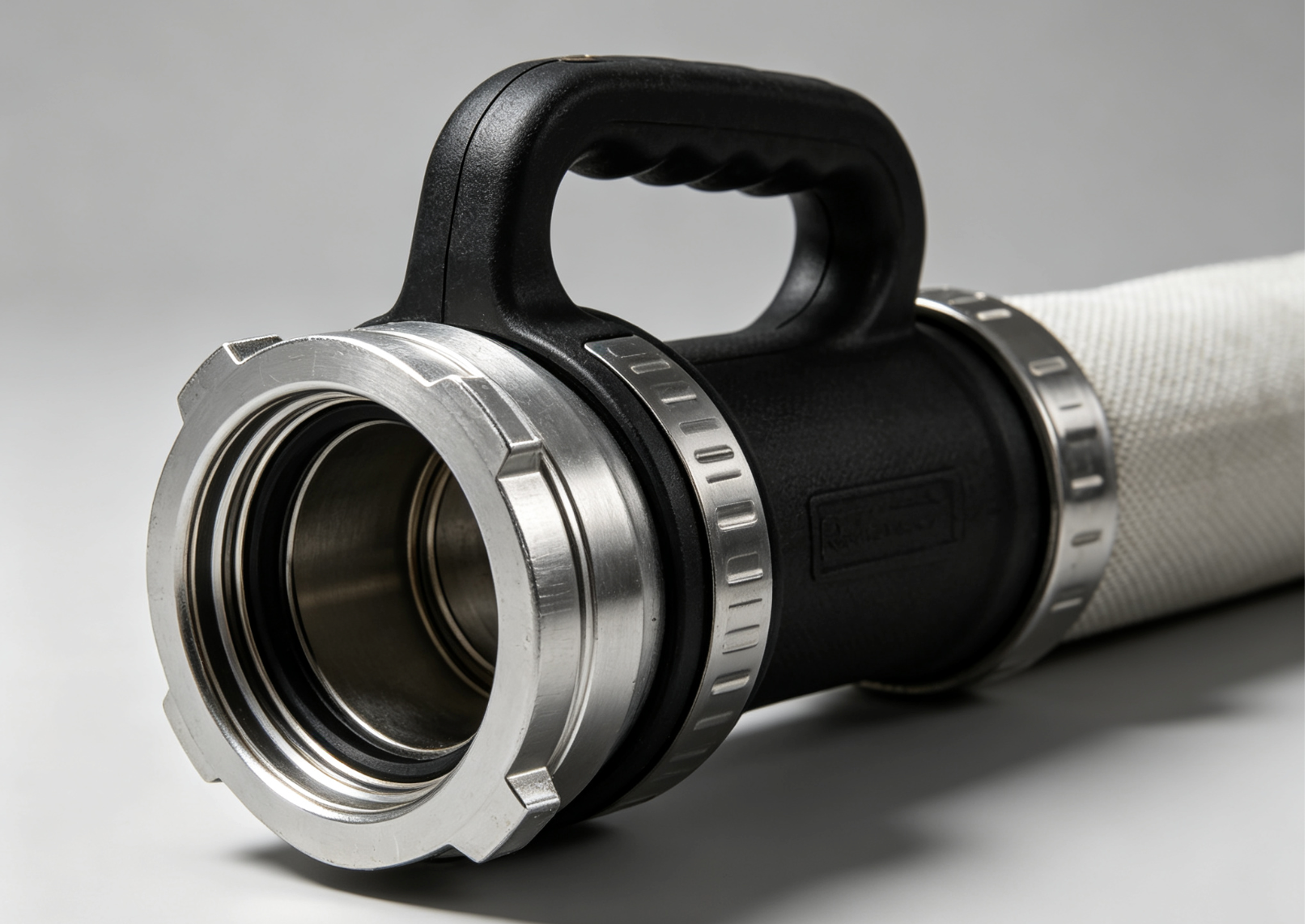
Which Fire Nozzle Certification Matters Most for Export Markets?
The correct certification depends on where the nozzle will be sold and installed. North American projects most often ask for UL or FM evidence, while other markets may prioritize local conformity documents, third-party test reports, or system integration approvals. The nozzle itself is usually evaluated on flow, shutoff behavior, durability, spray pattern, and pressure performance, but the acceptance path changes by country and project owner.
In export trade, the word “certified” can mean several things. It can mean a third-party listing, a product approval, a factory quality system audit, or a local conformity assessment. For a marine fire nozzle, for example, corrosion resistance and marine-class compatibility may be more important than a generic commercial building application. For a standard building hose line, the buyer may care first about hose reel integration, nozzle pattern control, and the ability to maintain stable discharge under specified pressure.
| Export Market | Common Buyer Expectation | Typical Evidence Requested | Why It Matters |
|---|---|---|---|
| United States / Canada | UL Listed or FM Approved | Listing certificate, test report, product marking | Supports code compliance and project acceptance |
| Middle East / Africa | Local civil defense or project approval | Third-party test data, COO, technical datasheet | Often tied to tender approval |
| Marine / Offshore | Application-specific conformity | Corrosion data, material traceability, salt spray results | Salt exposure and reliability are critical |
| OEM / Private Label | Specification match | Dimensional drawings, pressure test, compatibility proof | Brand owner needs repeatable supply |
UL Fire Nozzle and FM Approved Fire Nozzle: What Is the Difference?
UL and FM are not interchangeable, because they are different approval pathways with different scope and acceptance behavior. A UL Fire Nozzle is typically accepted when the product appears in a UL listing for the intended category and performance scope, while an FM Approved Fire Nozzle is accepted when the product meets FM Approvals’ criteria for the relevant use case. Buyers often ask for one or the other, and sometimes both, depending on consultant requirements, insurer preferences, or end-user policy.
For exporters, the important point is that a certificate is only useful within its scope. A nozzle approved for one pressure range, thread form, or spray duty may not automatically qualify for another. That is why many professional spec sheets include pressure, flow, material, thread standard, and intended application. This is especially important for complementary fire protection products, where buyers often evaluate the entire emergency response package rather than a single item.
| Item | UL / FM Focus | Export Review Point | Buyer Risk If Missing |
|---|---|---|---|
| Product listing | Listed or approved use | Matches bid specification | Rejection at submittal stage |
| Pressure rating | Must match system demand | Working pressure and test pressure shown | Leakage or unsafe operation |
| Flow performance | Nozzle discharge behavior | Flow at stated pressure | System underperformance |
| Connection standard | Thread or coupling compatibility | Matches local hose line | Cannot connect on site |
Fire Nozzle Certification Requirements by Application
The right certification package changes with the application, because fire nozzles are not used in one universal environment. A municipal hose line, a warehouse fire point, a marine deck system, and a commercial building riser all impose different expectations on durability, corrosion resistance, discharge pattern, and maintenance access.
In practice, exporters should classify the nozzle before they classify the certificate. Straight stream, fog, selectable pattern, and shutoff nozzles can face different acceptance rules, especially when the end user wants specific spray geometry. If the project also includes a water supply interface, products such as breeching inlets and couplings should be reviewed together to ensure the whole assembly remains compliant.
- Building protection: prioritize listing status, operating pressure, and thread compatibility.
- Marine protection: prioritize corrosion resistance, material grade, and stable discharge.
- Industrial sites: prioritize durability, shock resistance, and maintenance simplicity.
- OEM supply: prioritize repeatability, documentation, and dimensional consistency.
For many project buyers, the certification question is really a risk question. They want to know whether the nozzle can be installed without redesign, whether it will pass inspection, and whether it can be replaced years later with the same interface and performance. That is why OEM/ODM programs for export often include drawings, pressure tests, material certificates, and packaging control, not only the approval mark.
What Technical Data Should Be on an Export Fire Nozzle Datasheet?
A strong export datasheet reduces friction at every stage of procurement. The best datasheets make it easy for consultants, distributors, and fire contractors to compare products without asking for missing technical files.
At minimum, the datasheet should show the nozzle type, inlet thread, working pressure, test pressure, flow rate, spray pattern, material, finish, and applicable standard. If the product is a stainless steel product line or designed for aggressive environments, the material callout becomes even more important because corrosion resistance may determine service life more than the certificate itself.
| Datasheet Field | Recommended Content | Why Buyers Check It |
|---|---|---|
| Working pressure | Example: 1.0 MPa or project-specific range | Confirms system compatibility |
| Test pressure | Example: 1.5x working pressure, if stated by the test protocol | Shows pressure safety margin |
| Flow rate | Example: L/min at a stated pressure | Determines firefighting capacity |
| Thread standard | NST, BSP, NH, or local standard | Ensures connection fit |
| Material | Brass, aluminum alloy, stainless steel | Impacts durability and corrosion resistance |
Specifications are also a trust signal. A buyer is more likely to accept a datasheet that names the exact test method than one that uses vague terms like “high quality” or “strong pressure.” This is especially true in export channels where the procurement team may never see the factory in person.
How Standards Shape Fire Nozzle Export Compliance
Standards define what “compliant” means, and without them, export claims are difficult to defend. For nozzles used in fire hose systems, UL’s fire hose nozzle service is often reviewed alongside project specifications, while FM Approvals is commonly referenced in insurer-driven and high-risk facility procurement. For broader fire-protection context, the NFPA codes and standards portal is often consulted by designers, even when the product itself is not directly certified by NFPA.
When buyers ask for test credibility, they may also expect recognized laboratory methods. Hydrostatic pressure and leakage verification are often referenced in product validation plans, and material performance may be checked against corrosion or mechanical requirements. The U.S. National Institute of Standards and Technology publishes reference information and measurement guidance that supports reliable test practice, including its Guide for the Use of the International System of Units, which helps avoid unit errors in technical submissions.
For corrosion-sensitive exports, salt exposure is a practical concern. ASTM B117, the standard practice for operating salt spray apparatus, is widely used to evaluate corrosion resistance under controlled conditions, and its chamber conditions are explicitly defined in the standard. If your nozzle is intended for coastal, marine, or humid industrial projects, asking for salt spray evidence can be more persuasive than relying on appearance alone. See ASTM B117 for the test framework.
How to Choose the Right Certification Package for Your Export Order
The best certification package is the one that matches the target market, not the one with the longest certificate list. Many export failures happen because sellers submit a valid certificate for the wrong use case or the wrong market.
- Identify the destination country and end-use sector first.
- Confirm whether the buyer asked for UL, FM, local approval, or project-only evidence.
- Verify the nozzle type, pressure range, flow, and thread standard.
- Check whether the product will be used with hose reels, couplings, or other interfaces.
- Request the exact listing scope, test report, and product marking format before shipment.
This approach saves time because certification review is often more about alignment than complexity. A correctly documented nozzle can move smoothly through distribution, engineering approval, and site inspection. A technically good nozzle with the wrong paperwork can sit in a warehouse for months.
Common Export Mistakes Buyers and Suppliers Still Make
The most expensive mistakes are usually administrative, not mechanical. Many rejected shipments have acceptable hardware but incomplete documentation.
- Submitting a generic certificate without showing model number matching.
- Ignoring thread mismatch between the nozzle and the hose coupling.
- Using a pressure rating that does not match the system design.
- Failing to state the spray pattern or shutoff function clearly.
- Mixing different product families under one compliance claim.
These mistakes are avoidable if the supplier treats certification as part of product engineering. That is also why buyers often prefer exporters who can provide a full hardware set, including adapters and connectors, because interface control is one of the most common causes of installation delay.
Real-World Export Scenario: What a Distributor Usually Needs
A distributor usually needs more than a certificate PDF. They need a package that can survive local technical review, customs checks, and project submittals.
In a typical tender, the buyer may ask for product drawings, compliance documents, pressure test records, and sample photos of markings. If the order includes a public building or industrial site, they may also request traceability details, such as batch numbers and material declarations. For a mixed product package, that can include nozzles, hose reel cabinets, valves, couplings, and adapters, because the system will be judged as a whole.
One practical lesson: the closer the product is to the final application, the easier the approval. A nozzle approved for the right pressure, correct thread, and intended discharge pattern is far easier to sell than a generic model with incomplete data.
FAQ About Fire Nozzle Certification for Export
1. Is UL certification enough for all export markets?
No. UL is widely accepted in North America, but many destinations also require local approvals, project-specific acceptance, or additional test evidence. The right certificate depends on the destination market and application.
2. Is FM Approved better than UL Listed for fire nozzles?
Not necessarily. They serve different approval systems, and many buyers accept either one depending on the project specification. The key is matching the required standard, not ranking the labels.
3. What technical data matters most in export review?
Working pressure, flow rate, thread standard, spray pattern, material, and listing scope are usually the first items checked. Missing any of these can delay acceptance.
4. Do marine fire nozzles need special certification?
Often yes. Marine and offshore projects commonly care about corrosion resistance, material grade, and application-specific conformity in addition to the basic nozzle function.
5. Can one nozzle certificate work for every country?
Rarely. Certification scope is usually market-specific, and some countries or projects require their own conformity documents or local authority approval.
6. Why do buyers ask for test reports if a nozzle is already certified?
Because certificates prove scope, while test reports prove the actual batch or model performance. Buyers often want both to reduce project risk.
7. What should I verify before placing an OEM export order?
Confirm the destination market, target standard, pressure range, thread form, marking requirements, packaging language, and whether the product will be sold as part of a larger fire protection assembly.

Post time: Aug-17-2026