

Introduction
Choosing fire nozzles for a commercial cargo ship is not just a matter of matching thread size or spray pattern; the equipment must meet maritime certification rules that prove it will perform under shipboard fire-main pressures, corrosion exposure, and emergency use. This article explains which approvals matter most, including the SOLAS and FSS Code framework and, where applicable, EU Marine Equipment Directive compliance with Wheelmark certification. It also clarifies how class societies and flag-state requirements fit into the approval process, so readers can distinguish between general industrial nozzles and nozzles that are legally acceptable for installation on commercial vessels.
Why commercial cargo ships require certified fire nozzles
Commercial cargo ships operate in isolated environments where external firefighting assistance is rarely available. Consequently, the onboard fire main system and its terminal equipment, specifically the fire nozzles, must function flawlessly under extreme conditions. The International Maritime Organization (IMO) mandates strict regulatory frameworks to ensure that all firefighting apparatus meets rigorous performance and durability standards. For instance, under SOLAS Chapter II-2, the fire main must maintain a minimum pressure of 0.27 N/mm² (2.7 bar) for cargo spaces, requiring nozzles capable of handling sustained hydrostatic loads without failure or degradation.
Applicable maritime rules and approvals
The regulatory foundation for marine fire nozzles rests on the International Convention for the Safety of Life at Sea (SOLAS) and the associated Fire Safety Systems (FSS) Code. These frameworks dictate the baseline performance criteria for firefighting equipment. In the European jurisdiction, the Marine Equipment Directive (MED) 2014/90/EU translates these IMO requirements into actionable certification standards, culminating in the issuance of the ‘Wheelmark’. Equipment lacking these specific maritime approvals is legally prohibited from being installed on vessels flagged by signatory states.
Shipboard fire risks and operating conditions
Marine fire nozzles face environmental and operational stressors far exceeding those of terrestrial applications. They must resist severe galvanic corrosion induced by continuous exposure to saline environments, handle abrasive particulate matter potentially drawn through fire pumps, and operate reliably across ambient temperature ranges spanning from -20°C to +60°C. Furthermore, shipboard fires often involve complex fuel loads, including heavy fuel oil and hazardous cargo, necessitating nozzles that can seamlessly transition between a cooling water spray and a high-impact straight jet to penetrate deep-seated fires.
Required certifications for marine fire nozzles
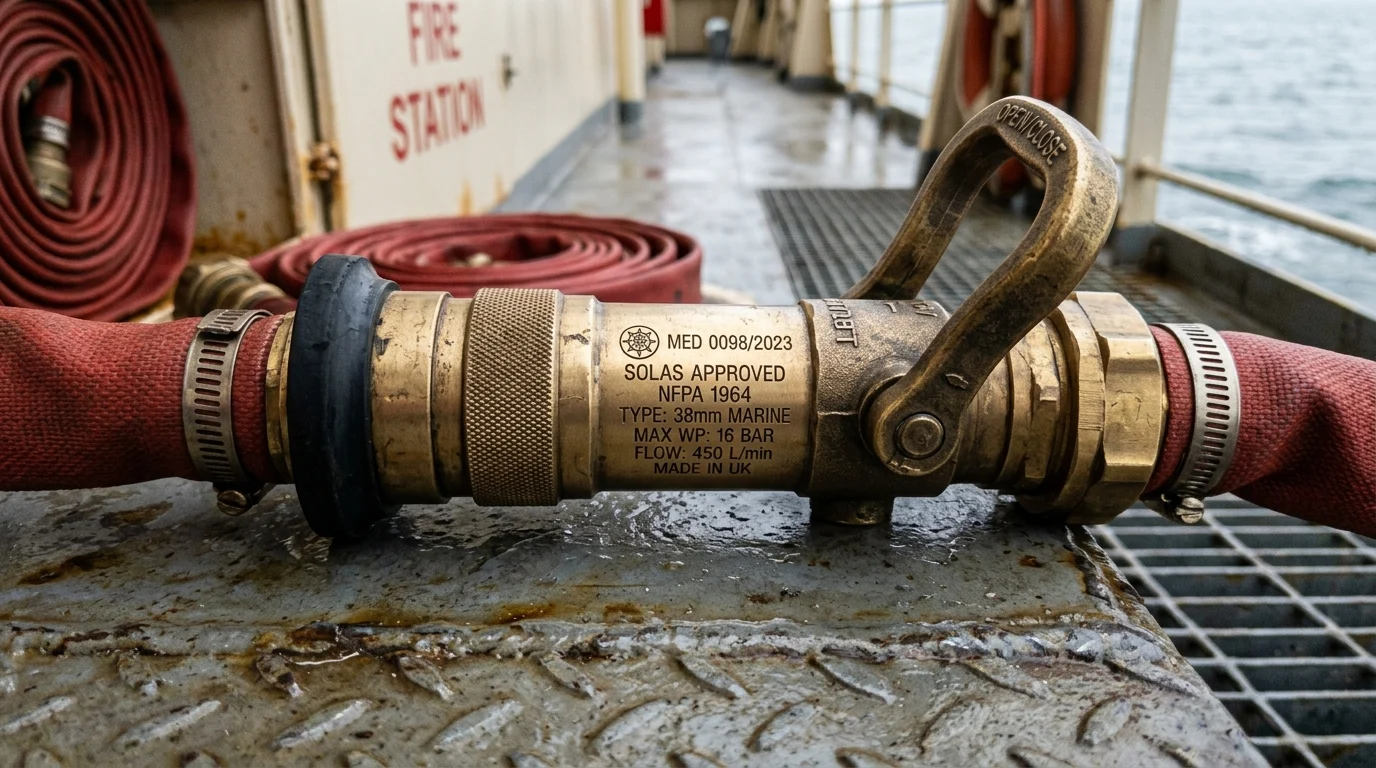
Navigating the certification landscape for marine fire nozzles requires an understanding of both global conventions and specific regional directives. Compliance is not a singular event but a continuous process of type approval and manufacturing quality assurance. A standard Marine Equipment Directive (MED) certification, for example, typically involves a Module B (Type Examination) valid for a maximum of 5 years, coupled with a Module D (Production Quality Assurance) which requires rigorous annual factory audits to maintain validity.
International standards and approval pathways
The technical performance benchmarks for marine fire nozzles are primarily defined by the EN 15182 standard series, specifically EN 15182-1 for general requirements and EN 15182-2 or -3 for combination branchpipes. These standards prescribe rigorous testing protocols, including hydrostatic pressure testing up to 16 bar, flow rate accuracy checks, and drop tests onto concrete surfaces from a height of 2 meters. Compliance with these international technical standards serves as the prerequisite for achieving broader maritime certifications.
Class and type approval requirements
Beyond statutory IMO and MED requirements, commercial vessels must satisfy the specific rules of their classification society. Members of the International Association of Classification Societies (IACS)—such as DNV, Lloyd’s Register, ABS, and Bureau Veritas—issue Type Approval certificates that validate the nozzle’s design against both international standards and the society’s proprietary maritime rules. A Type Approval certificate from a recognized IACS member is frequently demanded by shipowners and shipyards to ensure seamless integration into the vessel’s classed fire main system.
Mandatory vs optional documentation
Procurement professionals must distinguish between mandatory statutory documentation and optional, albeit beneficial, certifications. A Declaration of Conformity (DoC) and the physical affixation of the Wheelmark are mandatory for EU-flagged vessels. However, through the Mutual Recognition Agreement (MRA) between the United States Coast Guard (USCG) and the EU, a MED-certified nozzle can often be accepted on US-flagged vessels, provided the documentation explicitly states the USCG approval number. Conversely, manufacturer-issued certificates of conformity lacking third-party notified body validation carry no regulatory weight in commercial shipping.
How to evaluate technical specifications and certification evidence
Translating certification requirements into functional procurement criteria involves scrutinizing the technical specifications of the fire nozzles. Buyers must verify that the operational parameters listed on the certificate align precisely with the vessel’s fire safety plan and hydraulic calculations. For example, a standard dual-purpose marine nozzle must typically deliver a nominal flow rate of 400 L/min at a reference pressure of 6 bar, while maintaining a minimum effective throw distance of 12 meters in straight jet mode to ensure safe standoff distances for the crew.
Key nozzle specifications to verify
When evaluating specifications, the primary considerations include flow characteristics, material composition, and ergonomic design. Marine nozzles must be dual-purpose, allowing the operator to switch instantly between a protective water curtain with a spray angle of at least 90 degrees and a concentrated jet. Material selection is equally critical; while aluminum is common in municipal firefighting, marine environments demand copper alloys such as gunmetal or bronze, which exhibit superior resistance to seawater corrosion and dezincification. Additionally, the operating mechanism must be operable by personnel wearing heavy, insulated firefighting gloves.
Procurement comparison checklist
To ensure the selected equipment meets both operational and regulatory demands, procurement teams should utilize a standardized comparison framework. The following table highlights the critical differences between standard industrial nozzles and certified marine fire nozzles.
| Specification Category | Standard Industrial Nozzle | Certified Marine Fire Nozzle |
|---|---|---|
| Material Construction | Anodized Aluminum / Plastics | Gunmetal / Bronze / Brass alloys |
| Regulatory Approval | CE Mark / Local Fire Codes | MED (Wheelmark) / IACS Type Approval |
| Corrosion Resistance | Standard salt spray (e.g., 48 hours) | Marine-grade salt mist testing (e.g., 240+ hours) |
| Operating Pressure | Typically 3 to 7 bar | Validated up to 16 bar hydrostatic pressure |
| Flow Control | Often single-purpose or fixed | Dual-purpose (Jet/Spray) with shut-off capability |
Using this checklist ensures that the specified nozzles will pass class surveys and function reliably during an actual maritime emergency.
How to verify compliant fire nozzles before purchase
The proliferation of counterfeit maritime safety equipment necessitates rigorous due diligence prior to issuing any purchase orders. Relying solely on a vendor’s verbal assurance or a low-resolution PDF certificate exposes the vessel to severe operational and legal vulnerabilities. Verifying compliance requires cross-referencing provided documentation with official, centralized databases. A critical first step is examining the physical markings on the nozzle; a valid Wheelmark must be permanently embossed or engraved and accompanied by a 4-digit Notified Body identification number and the two-digit year of affixation (e.g., 0098/23).
Due diligence steps for buyers
Buyers must proactively authenticate all certification claims. This involves requesting the full Module B and Module D certificates and verifying their status directly on the European MarED database or the respective classification society’s online approval portal. It is crucial to check the exact model number and manufacturer name on the certificate against the quoted product, as vendors sometimes inappropriately supply uncertified variants under the umbrella of a certified brand. Furthermore, the Module D (production quality) certificate must be currently valid, as it expires more frequently than the Module B design approval.
Common documentation and substitution risks
Failing to thoroughly verify documentation introduces significant substitution risks. Supplying non-compliant fire nozzles can lead to immediate detention by Port State Control (PSC) authorities. A PSC detention not only disrupts cargo operations but also triggers mandatory reporting to international maritime databases, negatively impacting the vessel’s risk profile. Common pitfalls include accepting expired certificates, failing to notice that the approval covers a different nominal diameter (e.g., approving a 45mm nozzle but supplying a 65mm variant), or accepting standard EN 15182 compliance without the mandatory marine-specific MED or USCG endorsements.
Decision framework for selecting certified fire nozzles
Selecting the optimal fire nozzles for a commercial cargo vessel requires a strategic balance between upfront capital expenditure, long-term durability, and strict regulatory adherence. While the initial procurement cost of certified marine equipment is undeniably higher than terrestrial alternatives, the total cost of ownership is heavily influenced by the equipment’s lifespan and its impact on vessel operations. A vessel detained by Port State Control due to non-compliant firefighting equipment can incur commercial losses exceeding $10,000 to $30,000 per day in charter delays and port fees, dwarfing any savings realized during the procurement phase.
Balancing compliance, performance, and cost
A structured decision matrix helps fleet managers and procurement officers navigate the trade-offs between different nozzle options. The table below outlines a typical evaluation framework for selecting marine fire nozzles based on material and certification status.
| Evaluation Criteria | Bronze/Gunmetal (MED Approved) | Aluminum (MED Approved) | Uncertified Industrial Nozzle |
|---|---|---|---|
| Initial Capital Cost | High ($300 – $600+ per unit) | Medium ($150 – $300 per unit) | Low (< $100 per unit) |
| Lifecycle / Durability | 10 – 15+ years (Seawater resistant) | 3 – 5 years (Prone to galvanic corrosion) | Variable (Not designed for maritime use) |
| Compliance Level | Full Global Compliance | Full Global Compliance | Non-Compliant (Illegal for maritime use) |
| Maintenance Overhead | Low (Occasional flushing/lubrication) | High (Requires frequent fresh water flushing) | N/A (Will fail class inspection) |
By quantifying these variables, stakeholders can justify the higher initial investment in robust, fully certified materials.
Why fully documented nozzles reduce risk
Ultimately, investing in fully documented, high-quality fire nozzles serves as a critical risk mitigation strategy. Beyond ensuring the physical safety of the crew and the cargo, compliant equipment streamlines annual class surveys and minimizes friction during spontaneous port inspections. Furthermore, maintaining a pristine safety record with universally recognized firefighting apparatus can positively influence marine insurance premiums and underwriter risk assessments. By embedding strict certification verification into the procurement framework, shipping companies safeguard their operational continuity and uphold their commitment to maritime safety.
Key Takeaways
- The most important conclusions and rationale for fire nozzles
- Specs, compliance, and risk checks worth validating before you commit
- Practical next steps and caveats readers can apply immediately
Frequently Asked Questions
What certification is mandatory for fire nozzles on EU-flagged commercial cargo ships?
MED certification under the Marine Equipment Directive is mandatory, with the Wheelmark and Declaration of Conformity supplied by the manufacturer.
Do commercial cargo ships also need class approval for fire nozzles?
Often yes. Shipyards and owners commonly require Type Approval from an IACS society such as DNV, LR, ABS, or BV.
Which technical standard is commonly used to test marine fire nozzles?
EN 15182 is commonly used, covering nozzle performance, pressure testing, flow accuracy, and durability checks.
Can a general industrial nozzle be installed on a cargo ship?
Usually no. Marine installation typically requires maritime approval, not just a factory certificate, especially for classed or EU-flagged vessels.
What certification evidence should buyers request from suppliers like NBWorldFire?
Ask for the MED certificate, Wheelmark details, Declaration of Conformity, relevant IACS Type Approval, and current ISO 9001:2015 quality documentation.
Post time: May-28-2026