

Introduction
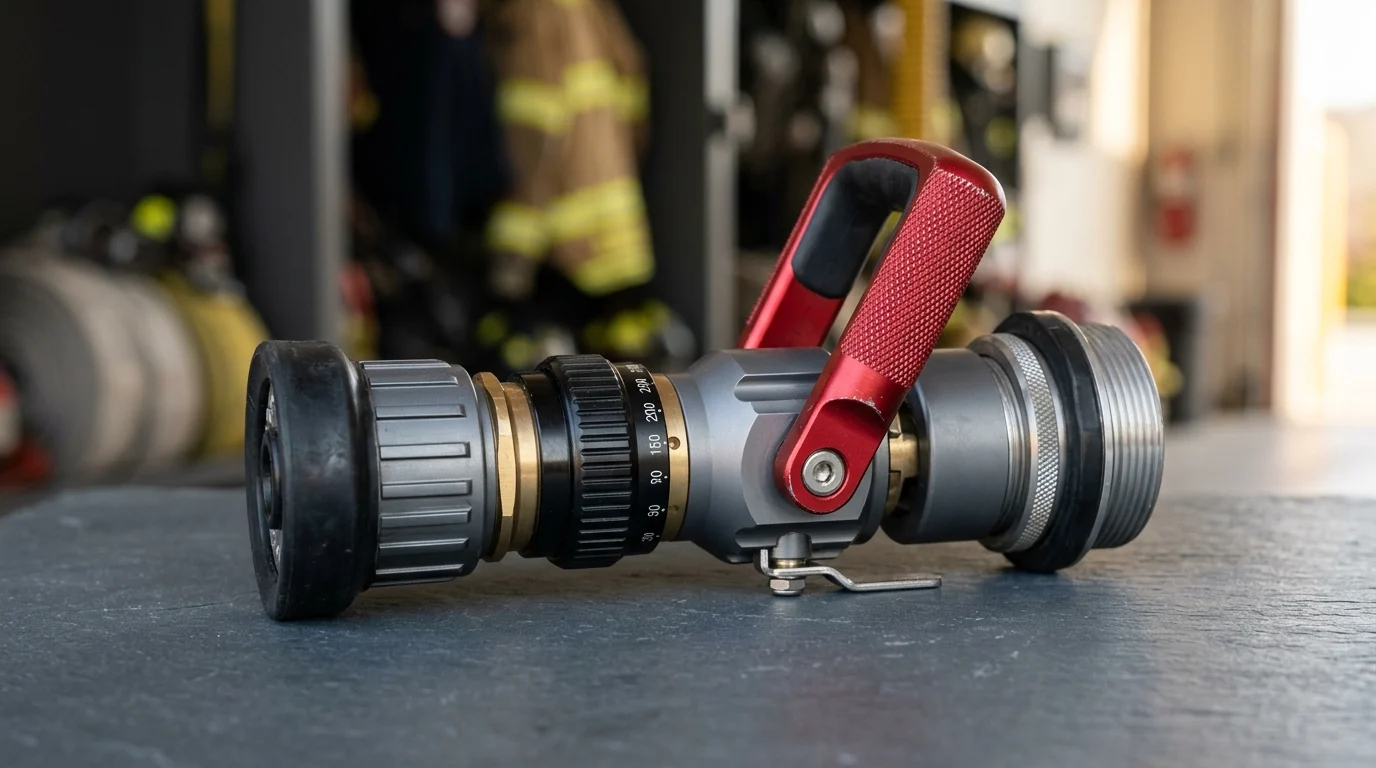
Choosing between automatic, selectable gallonage, and fixed gallonage nozzles affects far more than flow rate on paper; it determines stream quality, reach, operator control, and performance when pressure changes under real incident conditions. This guide explains how each nozzle type works, where each performs best, and what tradeoffs matter for industrial firefighting systems with variable water supply and evolving hazards. By the end, readers will be able to compare hydraulic behavior, match nozzle design to likely operating conditions, and make a more confident selection for applications where an automatic fire nozzle may offer clear operational advantages.
Why Automatic Fire Nozzle Selection Matters
Industrial firefighting operations take place in highly unpredictable environments where rapid changes in fire behavior and water supply dictate tactical success. The selection of the primary water delivery device—specifically the nozzle—is a critical engineering and procurement decision that directly impacts hazard mitigation and operator safety. Understanding the hydraulic mechanics behind different nozzle architectures is essential for optimizing industrial fire protection systems.
Incident Variability and Water Supply Limits
Industrial facilities frequently face fluctuating and unpredictable water supplies. A municipal grid or primary fire pump system might reliably provide 150 psi under normal conditions, but multiple hose lines, compromised mains, or reliance on secondary draft tanks can drastically reduce available pressure. Furthermore, a dynamic incident may require flow rates that shift rapidly from a 125 GPM localized cooling line to a master stream exceeding 500 GPM.
In these variable conditions, the delivery device must be capable of adapting to the hydraulic reality of the moment. If an industrial fire brigade encounters a sudden 30% drop in system pressure, traditional nozzles will suffer a proportional loss in stream reach and droplet velocity, potentially forcing personnel into dangerous proximity to radiant heat.
Operational Reliability in Industrial Firefighting
Operational reliability in industrial settings hinges on maintaining a coherent stream profile and adequate penetration to reach the seat of the fire. The automatic fire nozzle is engineered specifically to address pressure volatility by dynamically adjusting its internal geometry.
By automatically modulating the discharge orifice based on the incoming flow, these nozzles ensure that the stream maintains optimal velocity and reach even when the pump discharge pressure fluctuates between 50 psi and 100 psi. This self-regulating capability removes the burden of manual hydraulic calculations from the nozzle operator, allowing them to focus entirely on fire attack and exposure protection.
Automatic vs Other Fire Nozzle Types
Specifying the correct equipment requires a clear understanding of the mechanical and hydraulic distinctions between the three primary nozzle categories: fixed, selectable, and automatic. Each design approaches flow and pressure regulation differently, impacting everything from nozzle reaction force to foam aeration.
Definitions and Core Operating Principles
Fixed gallonage nozzles feature a constant, unyielding orifice size. They are designed to deliver a specific flow rate at a specific pressure (e.g., 150 GPM at 100 psi). Selectable gallonage nozzles allow the operator to manually adjust the orifice size via a rotating dial, typically offering preset flow rates such as 95, 125, 150, and 200 GPM.
An automatic fire nozzle, by contrast, utilizes an internal spring-loaded baffle mechanism. As water pressure at the inlet increases or decreases, the baffle spring compresses or expands. This variable orifice design continuously alters the discharge area to match the water volume being supplied by the pump.
Hydraulic and Pattern Control Differences
The primary hydraulic difference lies in pressure management. While fixed and selectable nozzles experience a linear drop in nozzle pressure when flow decreases, the automatic nozzle attempts to maintain a near-constant baseline pressure—most commonly calibrated to 100 psi, though low-pressure variants calibrated to 75 psi or 50 psi are increasingly common in industrial applications.
This constant pressure ensures that the pattern control—whether a straight stream for maximum reach or a wide fog for vapor mitigation—remains structurally sound. A fixed nozzle operating at half its rated pressure will produce a sagging, ineffective fog pattern, whereas an automatic nozzle will produce a well-defined, albeit lower-volume, fog pattern.
Pressure Range and Flow Performance Comparison
Comparing these technologies reveals distinct performance envelopes. Automatic nozzles provide the widest operational flow range without requiring manual intervention, but they can mask inadequate water supply from the pump operator, as the stream appears visually solid even at lower flow volumes.
| Nozzle Type | Flow Adjustment | Target Operating Pressure | Typical Flow Range (Handline) | Reaction Force Variability |
|---|---|---|---|---|
| Fixed Gallonage | None (Constant Orifice) | 50, 75, or 100 psi | Single rated flow (e.g., 150 GPM) | Highly variable based on pump pressure |
| Selectable | Manual (Rotating Ring) | 50, 75, or 100 psi | 30 – 200 GPM (Stepped) | Variable depending on selected setting |
| Automatic | Dynamic (Spring Baffle) | Constant (e.g., 75 or 100 psi) | 70 – 200 GPM (Continuous) | Optimized for constant pressure |
Understanding the nozzle reaction force—calculated roughly as NR = 1.57 × Flow (GPM) × √Pressure (psi)—is critical. Because an automatic nozzle maintains high pressure even at lower flows, the reaction force remains relatively high, requiring proper operator training to manage the hose line safely.
Key Trade-Offs in Industrial Nozzle Selection
Selecting the optimal nozzle architecture requires balancing hydraulic physics against the specific operational realities of the industrial environment. Buyers must weigh the benefits of automatic pressure regulation against the limitations it may impose on specialized firefighting tactics.
Hazard Type, Foam Use, and Exposure Conditions
Industrial hazards frequently involve flammable liquids requiring Class B foam application. The internal baffle of an automatic fire nozzle creates turbulence that aids in mechanical agitation, but non-aspirated automatic nozzles typically generate foam expansion ratios between 3:1 and 5:1.
While this ratio is generally adequate for standard Aqueous Film-Forming Foam (AFFF), it may fall short of the 7:1 to 10:1 expansion ratios preferred for certain Alcohol-Resistant (AR-AFFF) applications on polar solvents. In these cases, fixed nozzles with dedicated air-aspirating foam tubes often yield superior vapor-sealing blankets, making hazard specificity a primary driver in selection.
Hose Layout, Pump Capacity, and Nozzle Pressure
Friction loss in hose layouts heavily influences nozzle performance. Pushing 250 GPM through 200 feet of standard 1.75-inch hose yields approximately 80 psi of friction loss. If an industrial pump is capped at a 150 psi discharge pressure, the maximum pressure reaching the nozzle will be 70 psi.
Under these constraints, a standard 100 psi automatic fire nozzle will fail to fully open its baffle, restricting flow and potentially compromising the attack. In facilities with extensive hose lays or limited pump capacities, low-pressure automatic nozzles (calibrated to 75 psi or 55 psi) or fixed-gallonage nozzles matched to the exact hydraulic calculations are necessary to prevent flow starvation.
When Automatic Nozzles Perform Best
Automatic nozzles perform best in sprawling petrochemical complexes, high-rise industrial structures, or scenarios with unpredictable standpipe pressures. When the primary water source is a municipal hydrant of unknown capacity, or when multiple teams are drawing from a shared manifold, the automatic nozzle’s ability to maintain a functional stream profile at 60 psi ensures that personnel are not left defenseless by sudden hydraulic pressure drops.
How Buyers Should Evaluate Industrial Fire Nozzles
Procurement of industrial fire nozzles must transcend basic flow requirements. Buyers must evaluate material integrity, regulatory compliance, and lifecycle maintenance to ensure the equipment survives harsh industrial environments.
Standards, Testing, and Material Specifications
Industrial fire nozzles should comply with stringent international standards, notably NFPA 1964 (Standard for Spray Nozzles). This standard requires nozzles to pass rigorous durability tests, including withstanding a hydrostatic test of 900 psi before catastrophic failure, and surviving extreme temperature cycling.
Material specification is equally critical. For general industrial use, hard-coat anodized aluminum (compliant with MIL-A-8625 Type III, Class 2) offers an ideal balance of lightweight ergonomics and corrosion resistance. However, for offshore platforms or chemical plants with highly corrosive atmospheres, heavier cast brass or specialized stainless steel alloys are mandatory to prevent premature degradation.
Durability, Maintenance, and Spare Parts
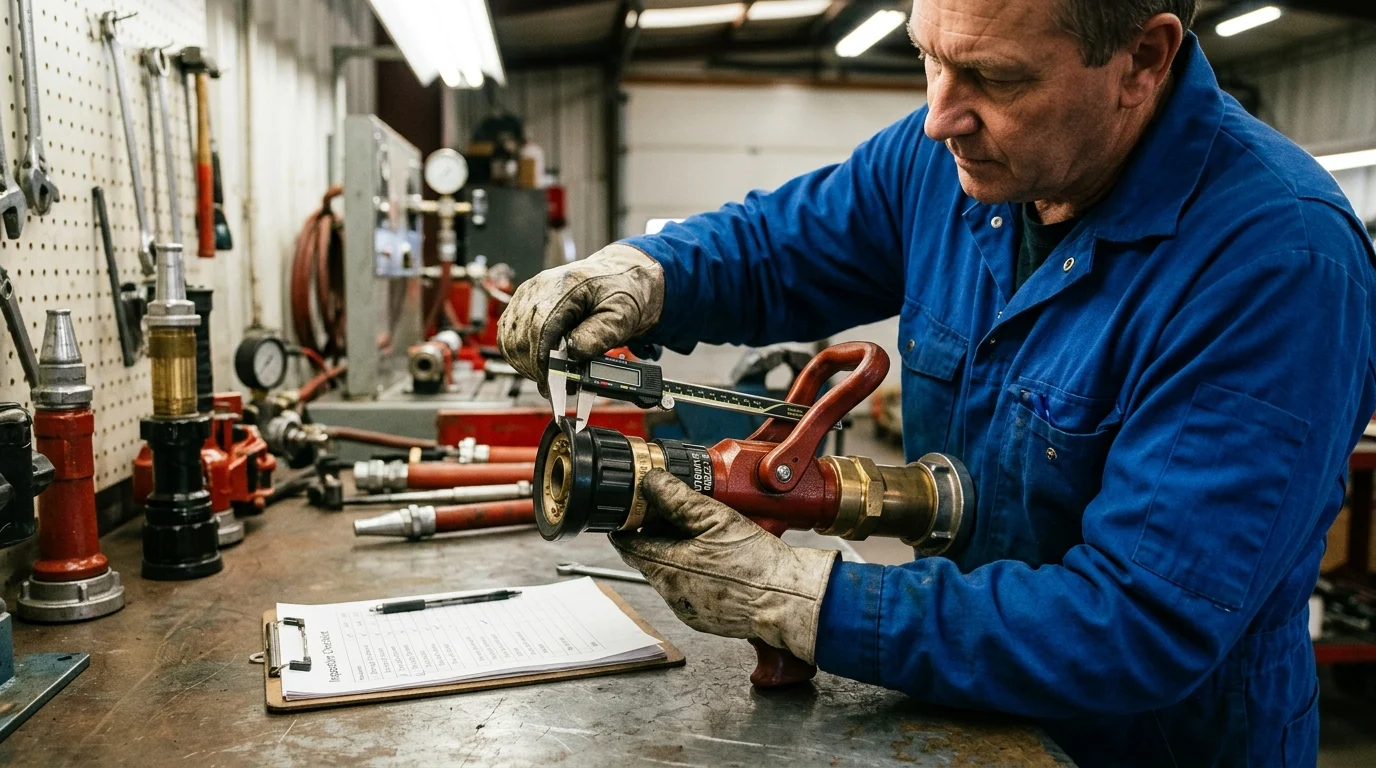
Because an automatic fire nozzle relies on moving internal parts—specifically the calibrated slide valve and baffle spring—it is more susceptible to debris than a fixed-orifice nozzle. Rust, scale, or biological matter from industrial draft tanks can jam the baffle mechanism.
To mitigate this, buyers must specify nozzles with a dedicated “flush” setting capable of passing solid particulate matter. A minimum clearance of 0.25 inches (6.35 mm) during the flush cycle is recommended to clear standard debris without requiring the nozzle to be shut down and disassembled during an active incident.
Sourcing and Specification Checklist
When drafting procurement specifications or RFQs, buyers should utilize a structured matrix to ensure all technical and commercial requirements are met by the manufacturer.
| Specification Category | Key Parameters to Define | Industrial Benchmark / Threshold |
|---|---|---|
| Performance | Target Pressure & Flow Range | e.g., 75 psi target, 70-200 GPM range |
| Material & Coating | Body Material & Anodizing Standard | MIL-A-8625 Type III Aluminum or Brass |
| Inlet Connection | Thread Standard & Swivel Type | 1.5″ or 2.5″ NH/NST, BSP, or Storz |
| Maintenance | Particulate Clearance (Flush) | Minimum 0.25-inch debris passage |
| Commercial | Warranty & MOQ (Minimum Order Quantity) | 5-year warranty, MOQ 10-50 units |
Ensuring thread compatibility (e.g., NH/NST vs. BSP) and specifying full-time swivel inlets to prevent hose kinking are minor details that prevent major deployment failures.
A Practical Decision Process for Choosing an Automatic Fire Nozzle
A systematic approach to procurement ensures that the selected automatic fire nozzle aligns with tactical objectives, infrastructure capabilities, and budget constraints. Navigating this decision requires a clear framework to avoid common specification pitfalls.
Step-by-Step Selection Framework
The selection framework begins with a comprehensive audit of the facility’s water supply to determine the minimum and maximum available GPM and psi. Next, buyers must define the primary hazards (e.g., gas vapor dispersion vs. combustible liquid blanketing) to dictate the required flow ranges.
For standard industrial handlines, an automatic nozzle rated for 75-150 GPM is typical, whereas heavy-duty master stream monitors may require automatic nozzles capable of 500-1000 GPM. Finally, evaluate the training level of the brigade; automatic nozzles require less hydraulic math but demand rigorous training to manage sustained reaction forces.
Common Specification Mistakes to Avoid
A frequent specification mistake is pairing an automatic fire nozzle with a fire pump equipped with an automatic pressure control governor. Because both devices are designed to independently adjust to pressure changes, they can engage in hydraulic “hunting.”
In this scenario, the pump and nozzle continuously overcorrect each other, causing dangerous pressure surges that can easily exceed 200 psi, risking hose ruptures and operator injury. When using automatic nozzles, pump operators must be trained to operate in RPM mode rather than pressure mode to ensure system stability.
Balancing Flexibility, Safety, and Cost
Ultimately, the decision rests on balancing operational flexibility against capital expenditure. Automatic nozzles carry a cost premium—typically 20% to 40% higher per unit than fixed-gallonage alternatives, due to their complex internal machining and calibrated springs.
However, this upfront cost is frequently offset by operational versatility. By investing in automatic nozzles, industrial facilities reduce the need to stock multiple sizes of fixed nozzles, simplify tactical decision-making under stress, and ensure that firefighters maintain a safe, effective stream reach regardless of unseen hydraulic fluctuations.
Key Takeaways
- The most important conclusions and rationale for Automatic fire nozzle
- Specs, compliance, and risk checks worth validating before you commit
- Practical next steps and caveats readers can apply immediately
Frequently Asked Questions
What is an automatic fire nozzle?
An automatic fire nozzle uses a spring-loaded baffle to change its orifice size and maintain a near-constant nozzle pressure as supply conditions vary.
When should I choose an automatic nozzle over selectable or fixed gallonage?
Choose automatic nozzles when water supply and fire conditions change often, especially in industrial plants, marine use, or long hose lays where pressure can fluctuate.
What is the main limitation of an automatic fire nozzle?
It can make a stream look strong even when actual flow is reduced, so pump pressure and available water supply still need close monitoring.
Are low-pressure automatic nozzles better for industrial systems?
Often yes. Models rated at 75 psi or 50 psi can reduce nozzle reaction and work better where hose layouts or pumps cannot reliably support 100 psi operation.
Can NBWorldFire help B2B buyers select certified nozzle options?
Yes. NBWorldFire supplies industrial fire hose nozzles and related equipment, with options suited for global procurement, certification needs, and varied budget requirements.
Post time: Jun-01-2026